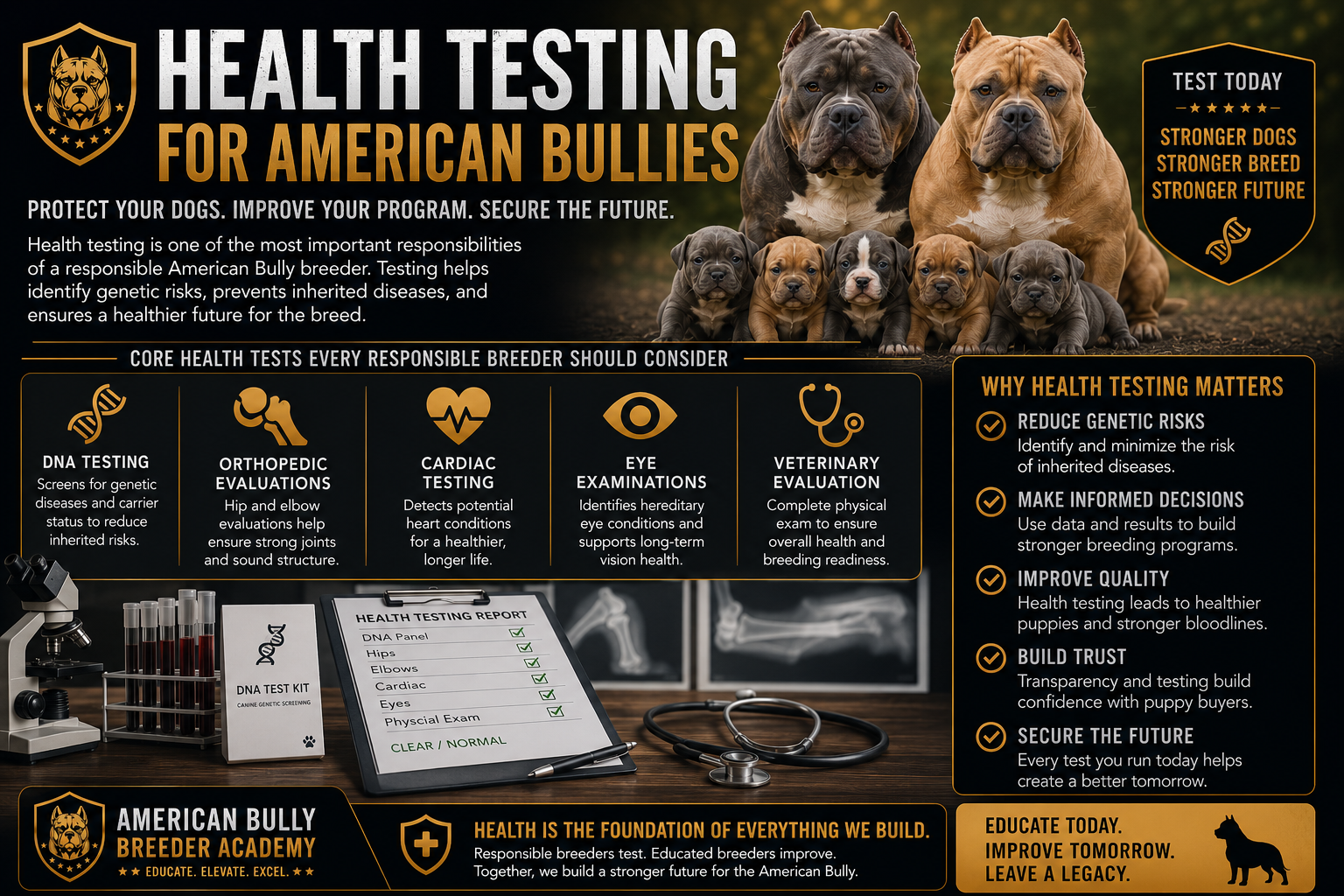
Health testing is one of the most important responsibilities of a responsible American Bully breeder.
While structure, temperament, and pedigree often receive significant attention, health is the foundation that supports everything else. A dog may possess outstanding structure and an impressive pedigree, but if serious health concerns are ignored, future generations can suffer the consequences.
Responsible breeders use health testing to make informed decisions, reduce genetic risks, improve breeding programs, and contribute to a healthier future for the breed.
This guide serves as the foundation of the Health Testing Academy and explains why health testing matters, what breeders should evaluate, and how testing helps create stronger American Bullies for generations to come.
Why Health Testing Matters
Health testing is about more than avoiding problems.
It is about making informed decisions.
Many inherited conditions cannot be identified through appearance alone. A dog may appear healthy while carrying genetic traits that could be passed to future generations.
Health testing helps breeders:
- Identify potential risks
- Make better breeding decisions
- Improve overall health
- Increase program consistency
- Protect future generations
- Build trust with puppy buyers
Responsible breeding starts with knowledge.
Health testing provides that knowledge.
What Is Health Testing?
Health testing refers to evaluations and screenings designed to identify inherited diseases, structural issues, and medical conditions that may affect breeding decisions.
Testing may include:
- DNA screening
- Orthopedic evaluations
- Cardiac examinations
- Eye examinations
- Veterinary health assessments
Different tests evaluate different areas of health.
The goal is to gather information that helps breeders make responsible decisions.
Health Testing Is Part of Responsible Breeding
Health testing should never be viewed as optional.
Breeders invest significant time into:
- Bloodline research
- Structure evaluation
- Temperament assessment
Health testing belongs alongside these priorities.
Responsible breeders understand that improving the breed requires attention to health as well as appearance.
Continue Learning
→ Responsible American Bully Breeding Practices
Understanding Genetic Risk
Every dog inherits genes from both parents.
Some traits are desirable.
Others may increase the risk of inherited disease.
Genetic testing helps breeders:
- Identify carriers
- Understand inheritance patterns
- Reduce disease risk
- Make more informed pairings
Health testing does not eliminate every risk.
However, it helps breeders reduce preventable risks whenever possible.

Understand inheritance, bloodlines, DNA testing, and breeding strategy.
DNA Testing
DNA testing has become one of the most valuable tools available to modern breeders.
DNA screening helps identify genetic mutations associated with inherited diseases.
Testing can provide information about:
Clear Status
The dog does not carry the mutation.
Carrier Status
The dog carries the mutation but may not be affected.
At-Risk Status
The dog may be affected or capable of passing the condition to offspring.
Understanding genetic status helps breeders make smarter breeding decisions.
Orthopedic Evaluations
Structure and movement are closely connected to long-term health.
Orthopedic evaluations help assess:
- Joint health
- Skeletal development
- Structural soundness
These evaluations are particularly important for breeding stock because orthopedic problems can affect future generations.
Areas Commonly Evaluated
Hips
Hip evaluations help identify structural abnormalities and potential dysplasia concerns.
Elbows
Elbow evaluations assess joint development and soundness.
Healthy joints support movement, athletic ability, and longevity.
Cardiac Health Evaluations
Heart health is an important consideration for all breeding dogs.
Cardiac evaluations may help identify:
- Structural abnormalities
- Heart defects
- Functional concerns
Healthy cardiac function contributes to long-term quality of life.
Responsible breeders should discuss appropriate cardiac screening options with their veterinarian.
Eye Examinations
Vision plays a significant role in overall quality of life.
Eye examinations can help identify:
- Hereditary eye conditions
- Vision concerns
- Structural abnormalities
Routine eye evaluations may provide valuable information for breeding decisions.
Overall Veterinary Evaluation
Before entering a breeding program, every dog should undergo a comprehensive veterinary examination.
Areas often reviewed include:
- General health
- Body condition
- Reproductive health
- Physical condition
- Developmental concerns
A healthy breeding dog provides a stronger foundation for future generations.
Health Testing and Breeding Decisions
Health testing provides information.
The value comes from how breeders use that information.
Responsible breeders evaluate:
Individual Results
Understanding the dog’s health profile.
Family History
Looking beyond the individual dog.
Genetic Compatibility
Evaluating pairings carefully.
Program Goals
Making decisions that support long-term improvement.
Testing should guide breeding decisions rather than simply become a checklist.
Transparency Builds Trust
One of the benefits of health testing is transparency.
Puppy buyers increasingly want information about:
- Health
- Genetics
- Breeding practices
Breeders who openly discuss health testing often build stronger trust and credibility.
Transparency demonstrates commitment to the breed and future puppy owners.
Health Testing Is an Investment
Some breeders view health testing as an expense.
Successful breeders view it as an investment.
Health testing supports:
- Better breeding decisions
- Healthier puppies
- Stronger bloodlines
- Better program development
- Long-term breed improvement
The value extends far beyond a single litter.
Common Mistakes Breeders Make
Skipping Health Testing
Assuming a healthy-looking dog is automatically healthy.
Testing Too Late
Evaluations should occur before breeding decisions are made.
Ignoring Results
Testing only helps when breeders use the information.
Focusing Only on Appearance
Health should never take a back seat to color or trends.
Lack of Documentation
Keeping records is essential for long-term program improvement.
Health Testing and Program Development
Health testing becomes even more valuable when viewed across generations.
Breeders should track:
- Testing results
- Family health history
- Long-term outcomes
- Trends within bloodlines
Over time, this information helps improve consistency and strengthen breeding programs.

Protect your dogs. Improve your program. Secure the future.
[Explore Health Testing Education]
Continue Learning
→ Building an American Bully Breeding Program
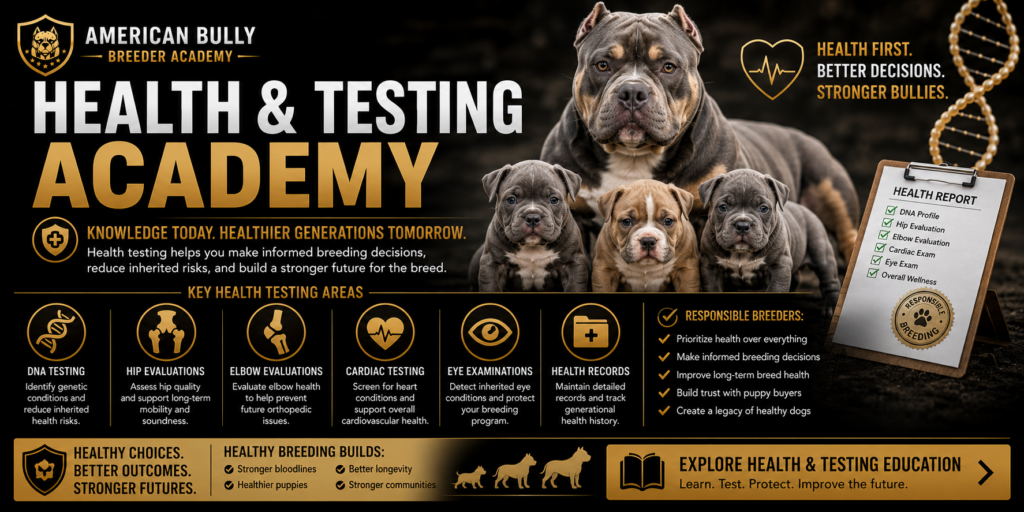
Health Testing Academy
Protect your dogs. Improve your program. Secure the future.
Learn how responsible breeders use health testing to make better breeding decisions and improve future generations.
[Explore Health & Testing Academy]
Building a Healthier Future
The future of the American Bully depends on responsible breeding decisions.
Health testing allows breeders to make decisions based on information rather than assumptions.
While no breeder can eliminate every possible risk, health testing helps reduce preventable problems and supports healthier generations.
Breeders who prioritize health contribute to a stronger future for the breed.
Final Thoughts
Health testing is one of the most valuable tools available to responsible American Bully breeders.
It helps identify risks, improve breeding decisions, strengthen breeding programs, and protect future generations.
Responsible breeding is not simply about producing puppies.
It is about creating healthier dogs, improving bloodlines, and preserving the future of the breed.
When breeders prioritize health alongside structure, temperament, and genetics, everyone benefits—including the dogs.
Continue Your Breeder Education
Previous Pillars
→ How to Become an American Bully Breeder
→ Responsible American Bully Breeding Practices
→ American Bully Genetics Explained
→ American Bully Bloodlines Explained
→ American Bully Structure Academy
→ How to Select Breeding Stock
→ American Bully Whelping Guide
→ Building an American Bully Breeding Program
Next Pillar
→ American Bully Breeder Business Guide
Future Health Testing Academy Articles
→ DNA Testing Explained for American Bullies
→ Understanding Genetic Carriers
→ Hip and Elbow Evaluations Explained
→ Cardiac Health Testing for Breeding Dogs
→ Eye Testing and Hereditary Conditions
→ Building a Health Testing Program
→ Understanding Health Test Results
→ Health Records and Breeding Decisions

Explore Capcity Bullys
See how structure, genetics, temperament, health testing, and responsible breeding come together in a real-world American Bully breeding program.
Breeder Academy Navigation
Previous: Building an American Bully Breeding Program
Next: American Bully Breeder Business Guide
Academy Track
Health Testing Academy
FAQ Questions
Why is health testing important for American Bullies?
Health testing helps breeders identify inherited risks, make informed breeding decisions, improve breeding programs, and protect future generations.
What health tests should American Bully breeders consider?
Breeders may consider DNA testing, orthopedic evaluations, cardiac screening, eye examinations, and comprehensive veterinary health assessments.
Can a healthy-looking dog still carry genetic diseases?
Yes. Many inherited conditions are not visible, which is why DNA testing and health screening are important breeding tools.
Does health testing guarantee healthy puppies?
No testing can eliminate all risks, but health testing significantly improves breeding decisions and helps reduce preventable inherited conditions.
When should breeding dogs be health tested?
Health testing should be completed before breeding decisions are made and updated when recommended by veterinarians or testing organizations.