Why Correct Front Structure Matters More Than Most Breeders Realize
Published by The American Bully Breed (TABB)
A Great American Bully Starts From the Front
When evaluating an American Bully, most people immediately notice the head, muscle, bone, and overall mass. While those features certainly contribute to the breed’s signature appearance, experienced breeders know that one of the most important structural areas is the front assembly.
The front assembly determines how efficiently a dog moves, how much stress is placed on its joints, and whether it can maintain proper structure throughout its life.
Unfortunately, it’s also one of the most misunderstood aspects of American Bully conformation.
In this guide, we’ll break down every major component of the American Bully front assembly, explain common structural faults, and show breeders how to evaluate front construction with confidence.

Master American Bully Structure
Learn how every part of an American Bully works together—from the headpiece and front assembly to the rear assembly, topline, movement, and overall balance.
What Is Front Assembly?
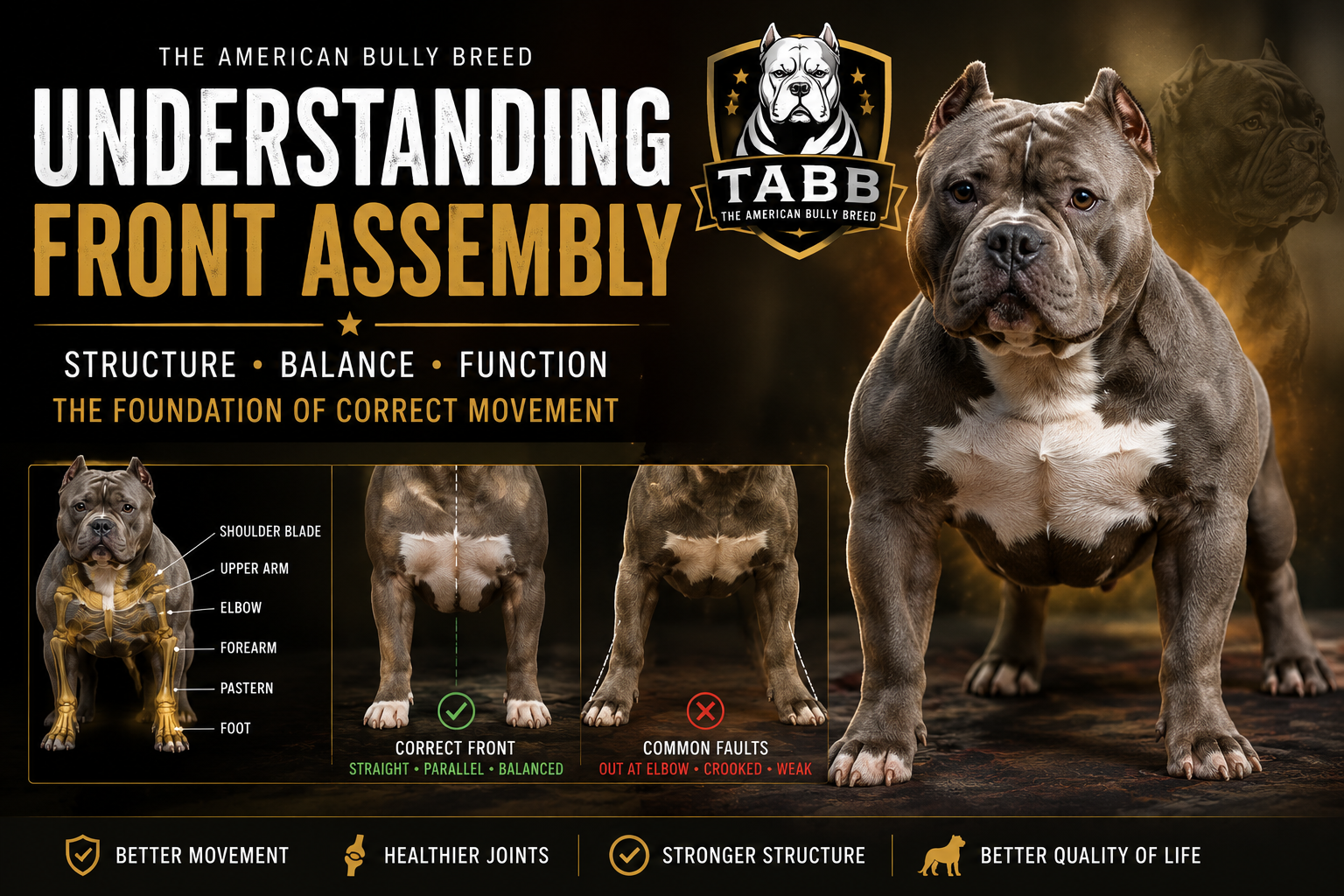
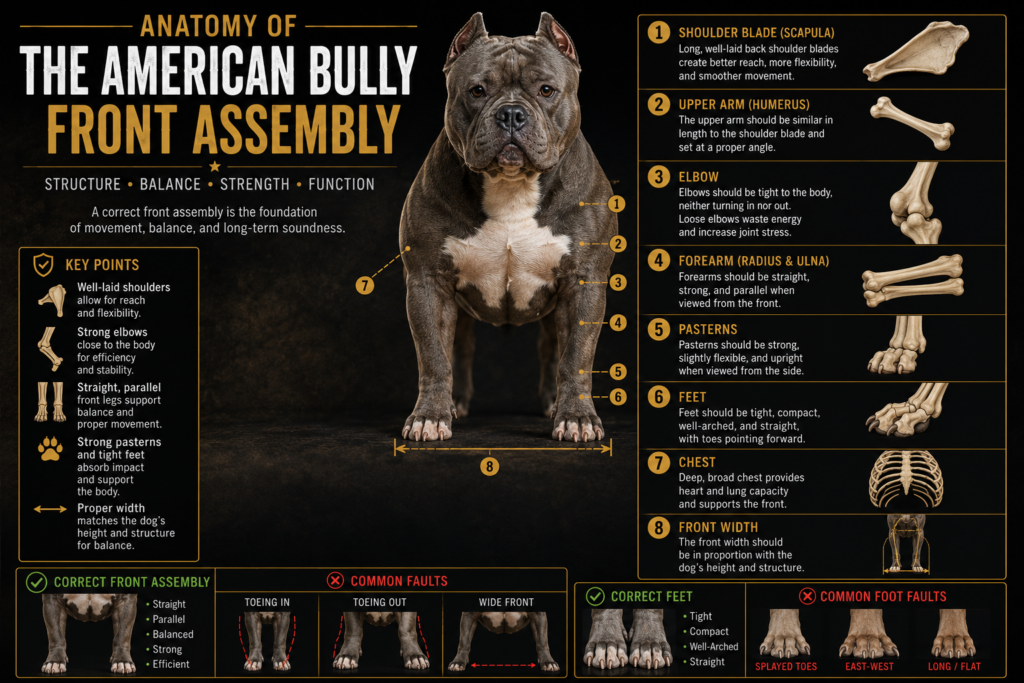
The front assembly refers to the collection of bones, joints, muscles, and connective tissues that make up the front portion of the dog’s body.
This includes:
- Shoulder blades (scapula)
- Upper arm (humerus)
- Elbows
- Forelegs
- Pasterns
- Feet
- Chest
- Front width
- Shoulder angulation
These parts must work together to support the dog’s weight while allowing smooth, efficient movement.
A beautiful head means very little if the dog cannot move correctly.
Why Front Assembly Matters
A properly constructed front allows the dog to:
- Move efficiently
- Maintain balance
- Absorb impact
- Protect joints
- Carry muscle correctly
- Develop proper reach
- Support heavy bone
Poor front construction often creates problems that worsen as the dog matures.
Front Assembly Influences Everything
Many structural issues actually begin in the front.
Incorrect front construction can lead to:
- East-west feet
- Toeing in
- Toeing out
- Elbow problems
- Restricted movement
- Poor reach
- Weak toplines
- Joint stress
- Early arthritis
Good breeders evaluate these characteristics before considering color or muscle.
The Shoulder Blade (Scapula)
The shoulder blade is one of the most critical bones in the front assembly.
Ideally, it should be:
- Long
- Well laid back
- Properly angled
- Tight against the body
Correct shoulder placement creates smoother movement and longer reach.
Steep shoulders produce shorter, choppier strides.
Why Shoulder Angulation Matters
The shoulder and upper arm should work together.
When correctly angled:
- Movement becomes fluid
- Stress is reduced
- Reach improves
- Balance increases
Poor shoulder angles force dogs to compensate with inefficient movement.
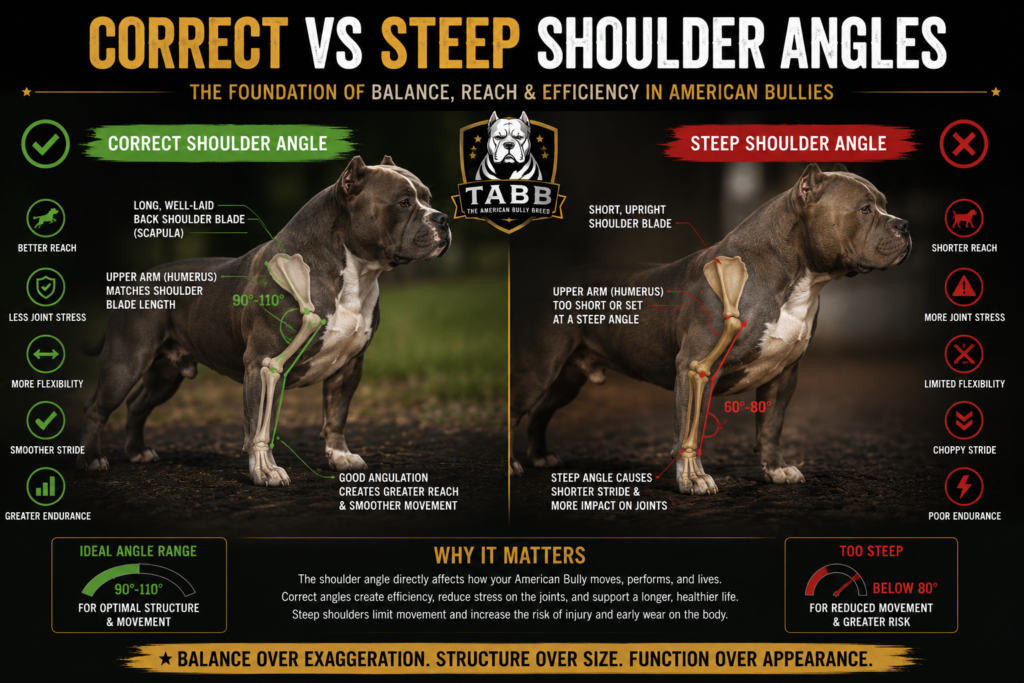
Understanding the Upper Arm (Humerus)
Many breeders overlook the upper arm.
However, its length dramatically affects movement.
Ideally:
- Similar length to the shoulder blade
- Proper angle
- Strong muscle attachment
- Smooth transition into the foreleg
A short upper arm often causes:
- Restricted stride
- Upright appearance
- Poor balance
Elbow Placement
Correct elbows should remain close to the body.
They should not:
- Wing outward
- Turn inward
- Rotate excessively
Loose elbows waste energy during movement and often indicate structural weaknesses.
Front Legs
Viewed from the front, the legs should appear:
- Straight
- Parallel
- Strong
- Well supported
From the side they should sit directly beneath the body.
Bow-legged or crooked fronts reduce efficiency and place extra stress on joints.
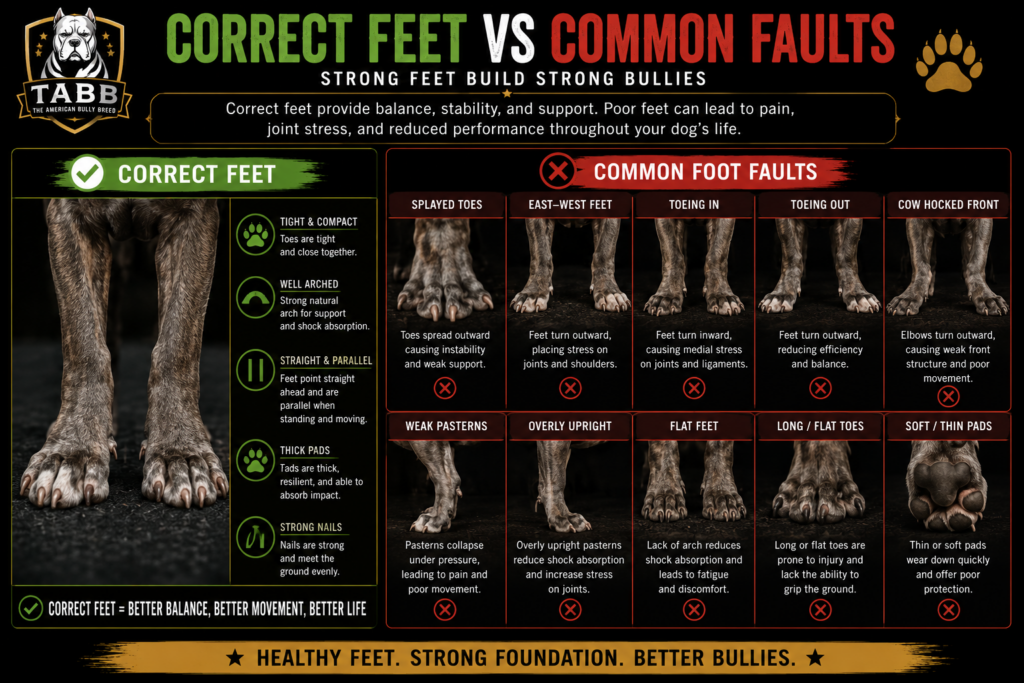
Pasterns
The pastern connects the foreleg to the foot.
Ideal pasterns are:
- Slightly flexible
- Strong
- Upright without being stiff
Weak pasterns often collapse under heavy bone.
Overly upright pasterns reduce shock absorption.
Feet
Strong feet complete the front assembly.
Ideal feet should be:
- Tight
- Compact
- Well arched
- Straight
Poor feet reduce stability and endurance.
Front Width
One of the biggest misconceptions in today’s American Bully community is that wider is always better.
This is false.
Correct width depends on:
- Height
- Bone
- Chest
- Overall balance
Excessive width often leads to:
- Restricted movement
- Rolling gait
- Poor endurance
- Joint stress
Balance always beats exaggeration.
Chest Development
The chest should be:
- Deep
- Broad
- Well developed
But it should never interfere with movement.
An overly exaggerated chest may prevent efficient front leg motion.
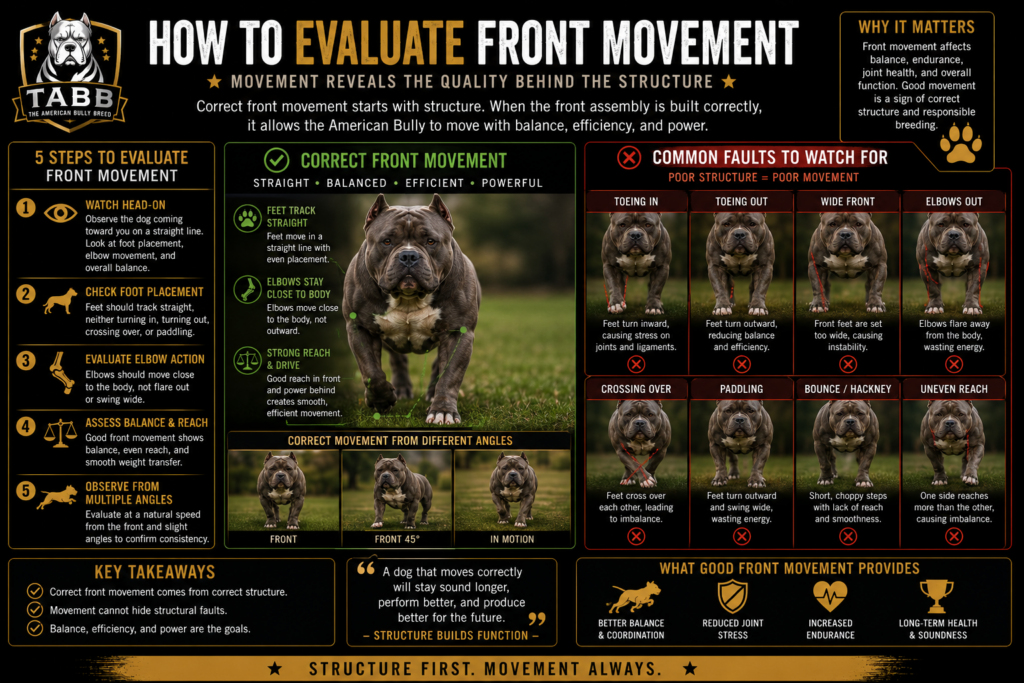
Movement Reveals the Truth
Structure is easiest to evaluate while the dog is moving.
Watch for:
- Smooth reach
- Straight travel
- Balanced stride
- Stable elbows
- Strong pasterns
- Parallel legs
Dogs with poor fronts often compensate by swinging their legs outward or shortening their stride.
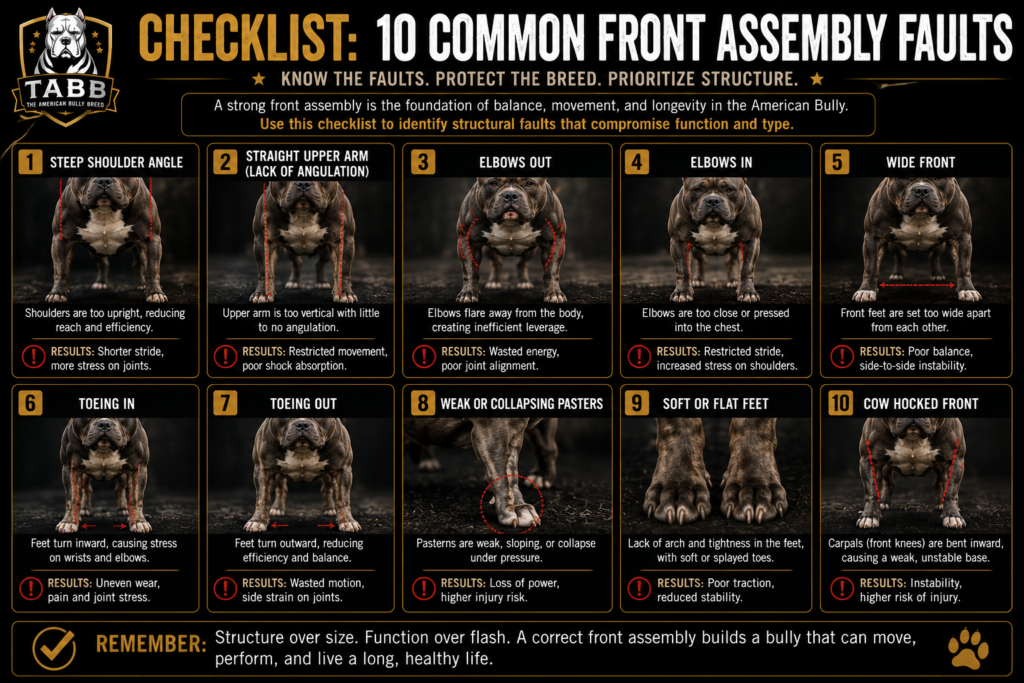
Common Front Assembly Faults
Experienced breeders learn to identify faults early.
Common issues include:
- East-west feet
- French front
- Bowed legs
- Loose elbows
- Steep shoulders
- Short upper arm
- Weak pasterns
- Narrow front
- Excessively wide front
- Crooked legs
Many of these faults become more noticeable as puppies mature.
Evaluating Puppies
Evaluating puppies requires patience.
Remember:
- Puppies grow unevenly.
- Growth stages create temporary changes.
- One evaluation is never enough.
Good breeders repeatedly evaluate puppies throughout development before making breeding decisions.
Breeding Better Front Assemblies
Improving structure begins with honest evaluation.
Responsible breeders should:
- Study pedigrees
- Evaluate movement
- Avoid doubling faults
- Select balanced pairings
- Prioritize health over trends
No dog is perfect.
The goal is continual improvement with each generation.
Why Buyers Should Care
Even pet owners benefit from understanding front assembly.
Correct structure often contributes to:
- Better movement
- Longer athletic life
- Reduced joint stress
- Improved comfort
- Better overall quality of life
A structurally sound dog is often healthier for years to come.
Final Thoughts
The front assembly is the foundation of every well-built American Bully.
While impressive heads and heavy muscle attract attention, correct shoulder placement, balanced angles, strong legs, and efficient movement determine whether a dog truly represents quality breeding.
Responsible breeders continually study structure because every breeding decision shapes the future of the breed.
Understanding front assembly isn’t just about producing beautiful dogs—it’s about producing healthier, more functional American Bullies for generations to come.
Explore Capcity Bullys

See Responsible Breeding in Action
At Capcity Bullys, every breeding decision prioritizes structure, movement, health, temperament, and long-term soundness. Discover how these same principles are applied in our breeding program.
Continue Learning in The American Bully Breed
Previous: How to Evaluate an American Bully’s Headpiece
Next: Understanding Rear Assembly in American Bullies (link to future article)
Related Reading:
- American Bully Structure Academy
- How to Select Breeding Stock
- Correct Proportions in the American Bully
- How to Evaluate an American Bully’s Headpiece
- Health Testing for American Bullies
- American Bully Breeder Business Guide
- Building an American Bully Breeding Program