

Published by The American Bully Breed (TABB)
American Bully Breeder Academy → Structure Academy
When evaluating an American Bully, individual features are easy to notice.
A massive head. A wide chest. Heavy bone. Muscular rear quarters. A short back.
But experienced breeders eventually learn an important lesson:
A collection of impressive individual features does not automatically create a well-structured dog.
Those features must work together.
That is where balance and proportion become essential.
Balance describes how harmoniously the different parts of the dog relate to one another. Proportion describes the relationship between dimensions such as height, body length, chest depth, leg length, head size, and overall mass.
A structurally impressive American Bully should not simply have more of everything. The dog should present as a complete, functional animal in which no single feature overwhelms the rest.
This guide explains how breeders can evaluate American Bully balance and proportion, why exaggeration can compromise the whole dog, and how these principles should influence breeding decisions.
If you’re new to structural evaluation, begin with the American Bully Structure Academy, which provides the foundation for understanding structure, movement, breed type, and breeder evaluation.
What Does Balance Mean in an American Bully?
Balance means that the dog’s structural components work together harmoniously.
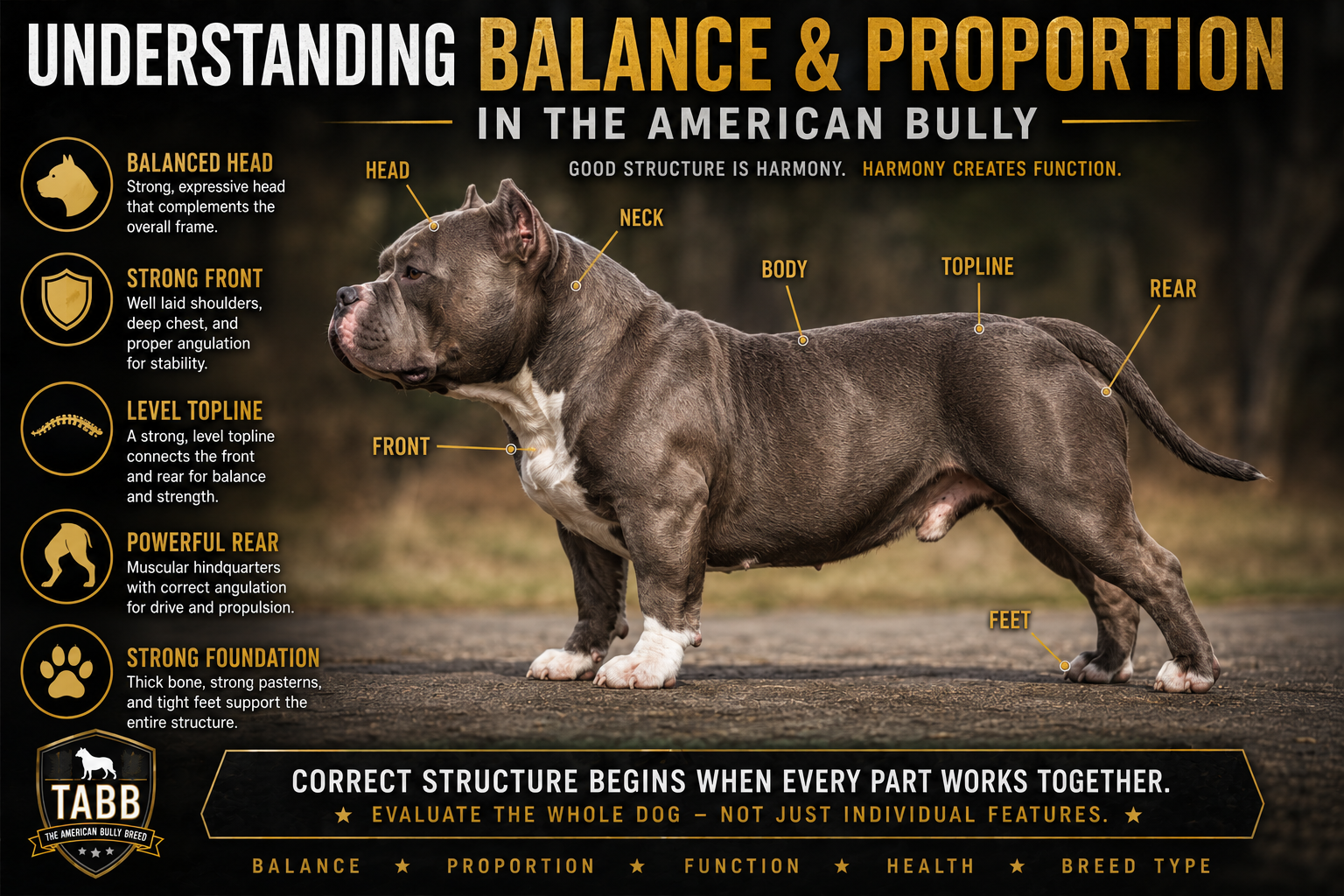
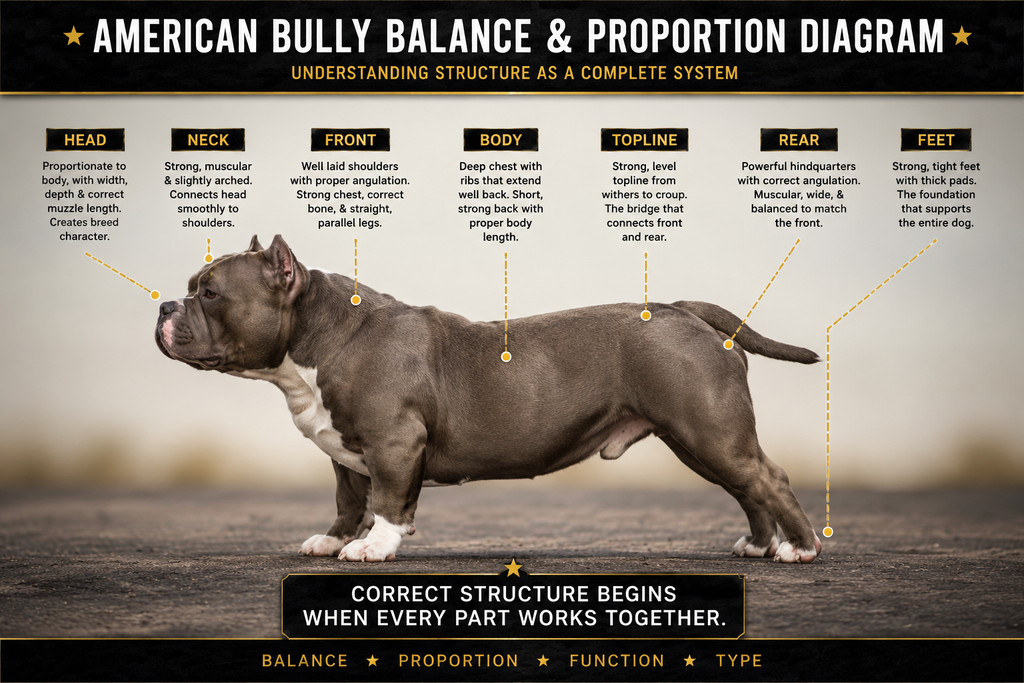
Think of the American Bully as a complete system rather than a collection of separate body parts.
The:
Head → Neck → Shoulders → Chest → Topline → Rear → Legs → Feet
must function together.
A dog may possess an impressive head, but if that head appears disproportionately large compared with its body, the overall picture loses balance.
A dog may have an extremely wide chest, but if the rear cannot match the front structurally, the dog can appear front-heavy.
Likewise, powerful rear angulation isn’t automatically desirable if the front assembly cannot complement it.
The goal is not maximizing individual features.
The goal is creating harmony between features.
TABB Structure Principle
More is not always better. Balanced is better.
This principle is already central to the Structure Academy, where TABB emphasizes balance over extremes and evaluates the dog as an interconnected structure rather than isolated traits. (The American Bully Breed)
What Is Proportion?
Proportion describes how the dimensions and features of the dog relate to one another.
Breeders evaluate relationships such as:
- Height compared with body length
- Leg length compared with body depth
- Head size compared with body size
- Chest width compared with rear width
- Bone compared with overall frame
- Neck length compared with body
- Front assembly compared with rear assembly
Proportion doesn’t mean every part should be equal.
It means each feature should make sense relative to the rest of the dog.
For example, the American Bully should possess substantial bone and muscular development.
But excessive mass on an inadequate frame doesn’t create better structure.
Likewise, making a dog increasingly shorter, wider, heavier, or more exaggerated doesn’t automatically make it a better representative of the breed.
The correct question is:
Does the feature improve the entire dog—or overpower it?
The Difference Between Type and Exaggeration
This distinction is especially important in the American Bully.
Breed type matters.
American Bullies should possess recognizable characteristics that distinguish them from other breeds. Bone, muscle, head type, chest development, and overall substance contribute to that appearance.
But breed type and exaggeration are not the same thing.
A breeder should not assume:
Bigger head = better head
Wider chest = better front
Shorter legs = better Bully
More muscle = better structure
More rear angulation = better movement
An exaggerated feature can actually reduce the quality of the overall structure when it interferes with proportion, movement, or function.
TABB’s broader breeding philosophy emphasizes evaluating health, structure, genetics, temperament, and breed type together rather than allowing a single fashionable characteristic to dominate selection decisions. (The American Bully Breed)
Head-to-Body Proportion
The American Bully head is one of the breed’s defining characteristics.
It should create breed presence without looking disconnected from the body supporting it.
When evaluating head-to-body balance, ask:
Does the head complement the dog’s frame?
Look at:
- Skull width
- Muzzle proportion
- Neck strength
- Shoulder mass
- Chest development
- Bone
- Overall body substance
A substantial head requires enough neck, shoulder, body, and bone to support the overall visual picture.
Conversely, a heavily built body paired with an insufficient head may lack desired breed type.
For a detailed examination of this area, continue with How to Evaluate an American Bully’s Headpiece, then return to the Structure Academy to evaluate the head as part of the entire dog.
The important point is:
Never evaluate the head in isolation.
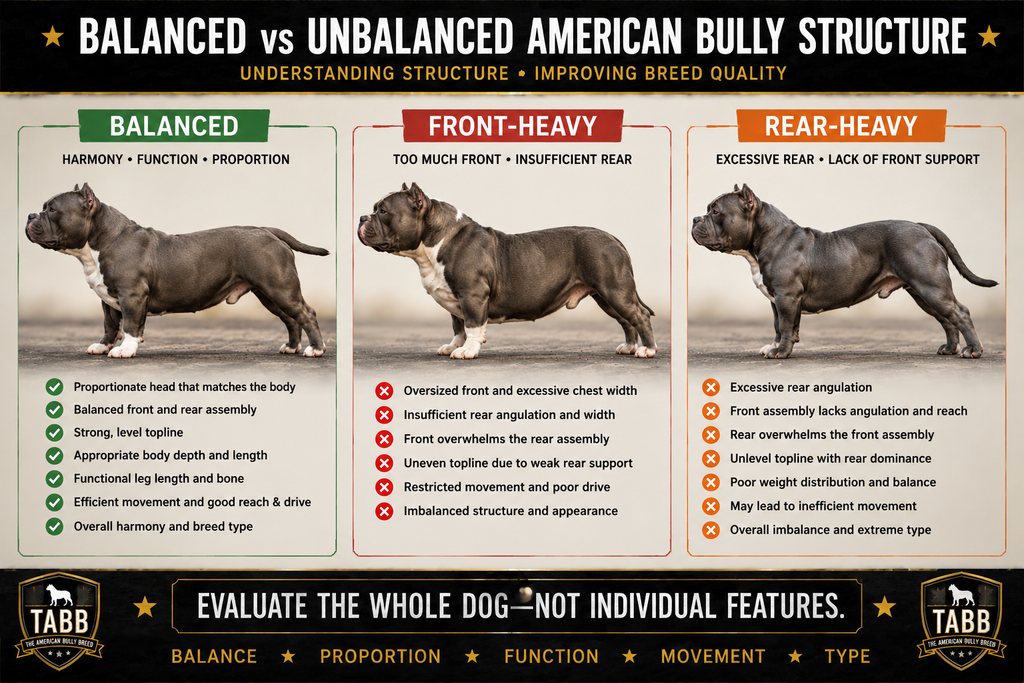
Front-to-Rear Balance
One of the most useful ways to evaluate an American Bully is to compare the front and rear assemblies.
A dog should not look as though its front belongs to one dog and its rear belongs to another.
The front influences support, reach, stability, and weight distribution.
The rear provides propulsion and drive.
These systems must complement each other.
TABB already covers both areas in greater depth through Understanding Front Assembly in American Bullies and Rear Assembly Explained, which are part of the Structure Academy learning path. (The American Bully Breed)
A Balanced Front and Rear
Look for harmony between:
Front angulation ↔ Rear angulation
Front width ↔ Rear strength
Shoulder construction ↔ Hindquarter construction
Front reach ↔ Rear drive
If the rear generates more drive than the front can accommodate, movement may become inefficient.
If the front is extremely wide and heavy while the rear is comparatively narrow or weak, the dog may appear unbalanced even while standing.
This is why breeders should evaluate the complete dog.
Body Length and Height
Body proportion is another critical part of evaluation.
An American Bully should present a powerful, compact appearance without becoming structurally compressed.
Breeders should examine the relationship between:
Height ↔ Length ↔ Depth ↔ Leg
rather than focusing exclusively on how short a dog appears.
A compact dog can still be proportionate.
But attempting to produce increasingly shorter dogs without considering the rest of the skeleton can create imbalance.
This becomes particularly important when evaluating Micro and very compact American Bullies.
Compact should never mean dysfunctional.
Chest Depth and Leg Length
Chest depth has a major influence on the overall appearance of the American Bully.
The breed should possess substance.
But breeders must evaluate chest depth relative to leg length.
When the body becomes excessively deep relative to the legs, the dog can begin appearing disproportionately low.
Conversely, excessive leg length relative to body depth can produce a taller, lighter appearance that may lack the substance associated with the breed.
Neither extreme should be the goal.
Breeders should look for a relationship that maintains:
- Substance
- Ground clearance
- Stability
- Movement
- Athletic ability
- Breed type
The dog should look powerful and remain functional.
Chest Width and Overall Balance
Chest width receives enormous attention in the American Bully community.
But wider isn’t automatically better.
Chest width should correspond appropriately with:
- Shoulder construction
- Rib cage
- Front legs
- Feet
- Body
- Rear assembly
Extreme width without proper construction can create inefficient movement.
This is why breeders shouldn’t evaluate a dog’s chest only from the front.
Observe the dog:
Standing from the front
Standing from the side
Moving toward you
Moving away from you
Moving laterally
Movement frequently reveals structural relationships that photographs conceal.
The TABB Structure Academy specifically treats movement as an important part of structural evaluation because a dog can look impressive while stacked yet reveal weaknesses once it begins moving. (The American Bully Breed)
Bone Must Match the Dog
Heavy bone is desirable within American Bully type.
But again, proportion matters.
Bone should complement the dog’s:
- Frame
- Height
- Body mass
- Feet
- Joint structure
- Overall substance
Breeders shouldn’t simply ask:
“Does this dog have heavy bone?”
Ask:
“Is the amount of bone appropriate for this dog’s entire structure?”
Extremely heavy bone placed on an inadequate structural foundation does not automatically improve the dog.
The same principle applies throughout conformation:
Quality comes from relationships between traits—not simply maximizing traits.
The Topline Connects the Dog
The topline visually and functionally connects the front and rear assemblies.
When evaluating overall balance, look at how smoothly the dog’s structure flows from:
Neck → Withers → Back → Loin → Croup → Rear
A strong topline contributes to stability and helps transfer movement between the front and rear.
The Structure Academy identifies the topline as one of the primary structural areas breeders should evaluate. (The American Bully Breed)
A dog can have an impressive front and strong rear but still lose overall structural quality if the middle cannot effectively connect them.
Think of the topline as the bridge between the dog’s two major assemblies.
Balance Should Be Evaluated From Multiple Angles
Never evaluate an American Bully from one photograph.
Social media has made this particularly important.
Photography can dramatically change how a dog appears.
Camera angle can make:
- Heads look larger
- Legs look shorter
- Chests look wider
- Backs look shorter
- Bone look heavier
A serious structural evaluation should include multiple perspectives.
Side View
Evaluate:
- Overall proportion
- Topline
- Body length
- Chest depth
- Front angulation
- Rear angulation
- Head-to-body relationship
Front View
Evaluate:
- Chest
- Shoulder relationship
- Front legs
- Feet
- Symmetry
Rear View
Evaluate:
- Rear width
- Alignment
- Hind legs
- Feet
- Symmetry
Movement
Evaluate:
- Reach
- Drive
- Stability
- Coordination
- Efficiency
- Overall balance
This is one reason experienced breeders learn to evaluate dogs rather than photographs.
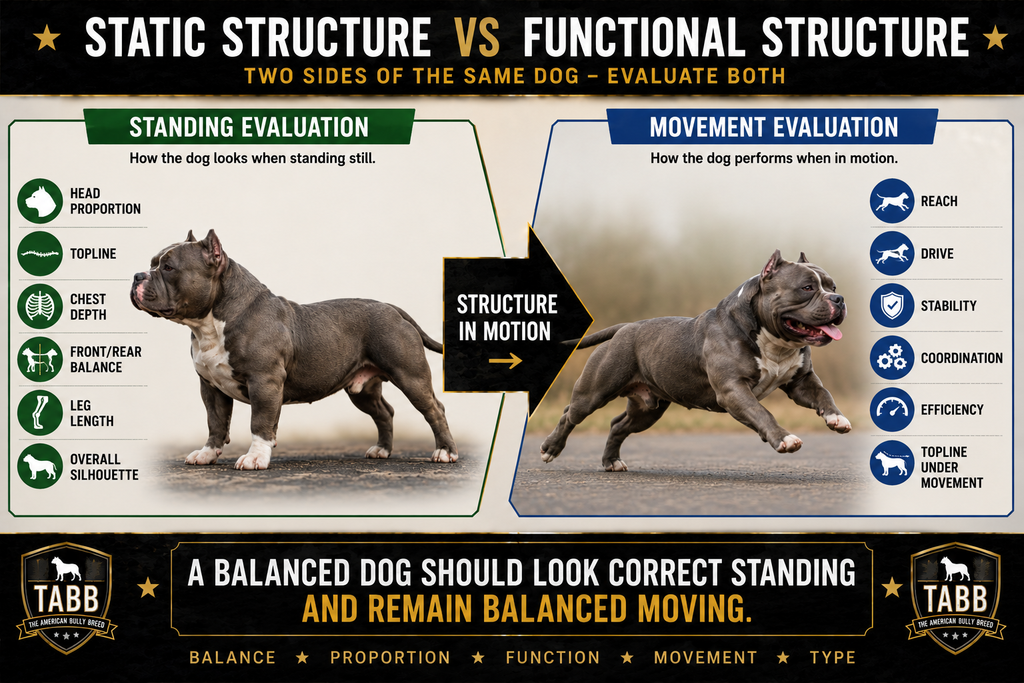
Static Balance vs Functional Balance
This is an important distinction.
A dog may appear beautifully balanced while standing.
That is static balance.
But when the dog moves, its structural components must work together.
That reveals functional balance.
A well-constructed American Bully should not simply look impressive when stacked.
It should remain coordinated while moving.
Watch for whether the dog:
- Maintains its topline
- Moves without unnecessary effort
- Uses its front and rear harmoniously
- Remains stable
- Tracks consistently
- Displays appropriate reach and drive
Movement is essentially structure being tested in real time.
Common Proportion Problems
Learning to recognize imbalance requires understanding what can disrupt it.
Oversized Head
An excessively large head relative to the body can overwhelm the dog’s overall silhouette.
Excessive Chest Width
Width without corresponding structural support may compromise balance and movement.
Excessively Short Legs
Reducing leg length without maintaining appropriate body proportions can create an overly compressed appearance.
Too Much Body Length
An overly long body can reduce the compact, powerful appearance expected of the breed.
Excessive Rear Angulation
A heavily angled rear paired with a more moderate front can create imbalance.
Insufficient Rear
A massive front combined with an underdeveloped rear produces another form of imbalance.
Excessive Body Mass
Weight and muscle can make a dog appear impressive while disguising underlying structural weaknesses.
Weak Feet or Pasterns
A massive body requires a strong foundation.
The feet and pasterns must support everything above them.
These aren’t simply cosmetic concerns.
Structure affects how the entire dog functions.
Common American Bully Proportion Faults
| Structural Area | Balanced | Potential Imbalance |
|---|---|---|
| Head | Matches frame | Overpowers body |
| Chest | Wide but functional | Excessively wide |
| Legs | Appropriate to body | Excessively short/tall |
| Front/Rear | Complementary | Mismatched |
| Topline | Strong and stable | Weak/unstable |
| Bone | Matches frame | Excessive or insufficient |
| Feet | Strong foundation | Weak/splayed |
| Movement | Efficient | Restricted/unstable |
TABB STRUCTURE ACADEMY — Evaluate the Complete Dog
Why Extremes Can Be Misleading
Extreme dogs often attract attention.
An unusually large head or exceptionally wide chest can create dramatic photographs.
But breeding decisions shouldn’t be based on which dog creates the strongest first impression.
Responsible breeders ask deeper questions.
Can the dog move efficiently?
Is the dog structurally balanced?
Does the feature complement the entire animal?
Can the dog comfortably function as a dog?
Would I want this trait intensified in the next generation?
That final question is especially important.
When selecting breeding stock, you’re not merely evaluating the dog standing in front of you.
You’re evaluating what that dog might contribute genetically.
TABB’s How to Select Breeding Stock guide emphasizes evaluating health, structure, genetics, temperament, and breed type together rather than allowing pedigree, popularity, color, or another isolated trait to determine breeding value. (The American Bully Breed)
Balance Is Especially Important in Breeding Decisions
Breeders must think differently from pet owners.
An owner can appreciate a dog for the individual it is.
A breeder must also ask:
What happens when these traits are passed forward?
Suppose a male has an exceptional head but is slightly front-heavy.
Pairing him with a female who is also front-heavy may reinforce the weakness.
A more strategic breeder might look for a female possessing:
- Stronger rear balance
- Complementary proportions
- Appropriate body length
- Strong feet
- Functional movement
The objective isn’t finding two identical dogs.
It is making a pairing in which the strengths and weaknesses of both animals are understood.
This is where structure connects directly with genetics.
TABB’s American Bully Genetics Explained notes that many structural traits—including shoulder placement, rear angulation, topline, bone, balance, proportions, and movement—are complex traits influenced by genetics rather than simple one-gene outcomes. (The American Bully Breed)
Don’t Breed Two Faults Together
One of the simplest principles a developing breeder can learn is:
Know what you’re trying to improve before making the breeding.
No dog is perfect.
Every dog possesses strengths and weaknesses.
The breeder’s job is to identify them objectively.
Before selecting a pairing, create two columns.
Strengths
What should be preserved?
Weaknesses
What needs improvement?
Then evaluate the potential mate.
Avoid selecting dogs simply because both are impressive individually.
Ask whether they are structurally complementary.
For more on developing this long-term approach, read Building an American Bully Breeding Program. TABB’s breeding-program framework emphasizes improving traits over generations rather than evaluating success from a single litter. (The American Bully Breed)
Balance Across Generations
One balanced dog doesn’t create a consistent breeding program.
Consistency requires evaluating generations.
Breeders should study:
Parents → Grandparents → Siblings → Previous Productions → Offspring
This provides information about whether the qualities seen in an individual are consistently represented within the family.
Pedigrees and bloodlines become valuable here.
A pedigree isn’t valuable simply because famous names appear on it.
Its real value comes from helping breeders understand the genetic background behind the dog.
TABB’s American Bully Bloodlines Explained emphasizes that pedigrees and bloodlines improve predictability but never replace evaluation of the individual dog’s structure, movement, temperament, and health. (The American Bully Breed)
A Simple American Bully Balance Evaluation
When looking at a dog, don’t immediately focus on details.
First stand back.
Look at the whole dog.
Then work inward.
Step 1 — Overall Impression
Does the dog immediately appear harmonious?
Step 2 — Head-to-Body Balance
Does the head complement the frame?
Step 3 — Height-to-Length Proportion
Does the body appear compact without being compressed?
Step 4 — Chest-to-Leg Relationship
Is there adequate substance while maintaining functional ground clearance?
Step 5 — Front-to-Rear Balance
Do the assemblies complement one another?
Step 6 — Topline
Does the dog’s middle connect the front and rear effectively?
Step 7 — Bone and Feet
Can the foundation appropriately support the dog?
Step 8 — Movement
Does the structure remain balanced once the dog begins moving?
Only after evaluating the complete dog should you focus heavily on individual features.
Breeder Evaluation Checklist
Before considering an American Bully structurally balanced, ask:
✓ Does the dog look proportionate from a distance?
✓ Does the head complement the body?
✓ Does the neck transition appropriately into the shoulders?
✓ Are the front and rear assemblies complementary?
✓ Is chest depth appropriate relative to leg length?
✓ Is the chest wide without compromising function?
✓ Does the topline remain strong?
✓ Does the bone match the frame?
✓ Are the feet capable of supporting the dog’s mass?
✓ Does the dog maintain balance while moving?
✓ Is breed type present without excessive exaggeration?
✓ Would I want these proportions reproduced in the next generation?
That last question transforms conformation evaluation into breeder evaluation.
Balance Over Extremes
American Bully breeders constantly make choices.
More bone?
More head?
More chest?
Shorter?
Wider?
More muscle?
Those questions can lead breeding programs in the wrong direction if they aren’t followed by a more important question:
Does it improve the whole dog?
The best feature isn’t necessarily the largest feature.
The best feature is the one that contributes to a balanced, functional, recognizable American Bully.
Good breeding isn’t a competition to maximize individual traits.
It’s the long-term process of bringing desirable traits together in proportion.
Final Thoughts
Understanding balance and proportion in the American Bully is one of the most important skills a breeder can develop.
Begin by looking at the whole dog.
Then evaluate the parts.
Study:
Head → Front → Body → Topline → Rear → Legs → Feet → Movement
Then put everything back together.
A great head doesn’t compensate for an inadequate rear.
A massive chest doesn’t compensate for poor movement.
Heavy bone doesn’t compensate for weak feet.
And extreme features don’t automatically create exceptional breed type.
The goal is harmony.
Structure should create function.
Proportion should create balance.
Breed type should exist without sacrificing soundness.
And every breeding generation should move the program closer to that goal.
Continue Your Structure Education
Previous
→ Learn to Identify Correct American Bully Structure: A Breeder’s Evaluation Guide
Structure Academy
→ American Bully Structure Academy
Continue With
→ Common Structural Faults in American Bullies: A Breeder’s Guide
Related Structure Education
→ Understanding Front Assembly in American Bullies
→ Rear Assembly Explained: Understanding the American Bully Rear Assembly
→ How to Evaluate an American Bully’s Headpiece
Explore the American Bully Breeder Academy
Balance and proportion are only one part of building better dogs.
Continue studying genetics, health testing, structure, whelping, puppy development, breeding-program development, and breeder business practices through the TABB American Bully Breeder Academy.

Looking for a Well-Structured American Bully?
Explore Capcity Bullys and learn more about our American Bully program, breeding philosophy, bloodlines, and available puppies.
[Explore Capcity Bullys →]