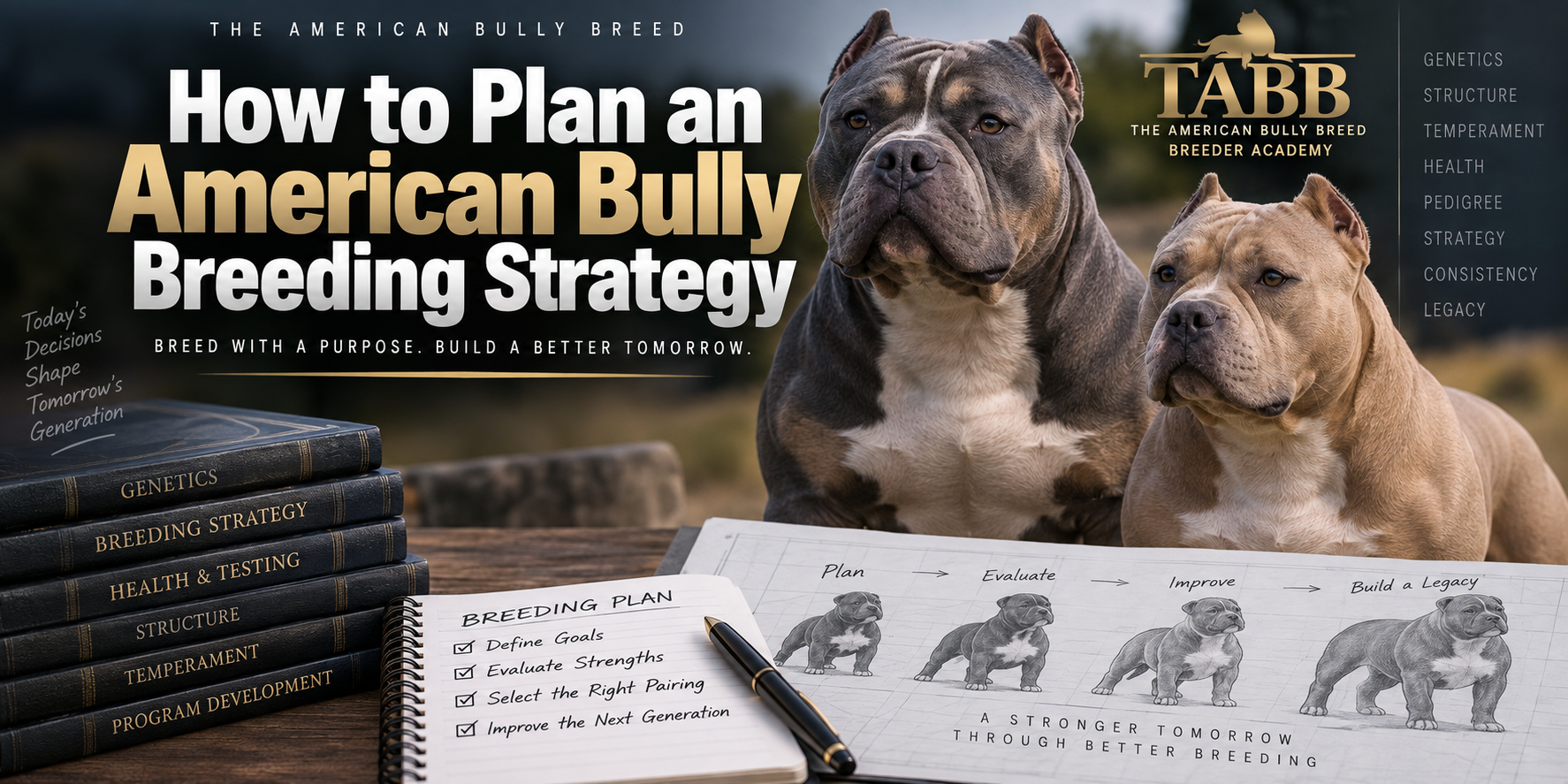

A successful American Bully breeding strategy begins long before a female comes into heat or a stud is selected.
The strongest breeding programs approach each pairing as part of a larger, multi-generation plan.
Instead of asking only:
“Which male should I breed to this female?”
a breeder should also ask:
“What does my program need, what can this pairing realistically contribute, and how could the offspring move the next generation forward?”
That distinction is important.
Producing a litter is an event. Developing a breeding program is a process involving genetics, health, structure, temperament, pedigree evaluation, puppy selection, record keeping, and repeated evaluation over time.
This guide from The American Bully Breed Breeder Academy (TABB) explains how to develop an American Bully breeding strategy based on purpose rather than popularity.
If you are just beginning to define your program, start with How to Set Goals for an American Bully Breeding Program and How to Develop an American Bully Breeding Philosophy before developing individual pairing strategies.
What Is an American Bully Breeding Strategy?
A breeding strategy is the practical plan used to move a breeding program from its current position toward its long-term goals.
There are three connected layers:
Breeding Goals
What are you trying to produce?
Breeding Philosophy
What principles will guide your decisions?
Breeding Strategy
What specific decisions will move the program toward those goals?
For example, suppose a breeder wants to establish a line of American Bullies with balanced structure, strong breed type, stable temperament, predictable size, and improved consistency.
The breeding strategy determines how the breeder will:
- Select foundation dogs
- Evaluate potential mates
- Use pedigrees
- Consider genetic relationships
- Address weaknesses
- Preserve strengths
- Introduce outside genetics
- Select keeper puppies
- Evaluate offspring
- Plan subsequent generations
A breeding strategy therefore extends beyond a single sire and dam.
It connects today’s breeding decision with tomorrow’s breeding program.
1. Start With the Program — Not the Stud
Stud selection often receives enormous attention in American Bully breeding.
But the strategy should begin with your program.
Before looking at available studs, evaluate what you currently have.
Ask:
What are my program’s strongest characteristics?
Which weaknesses appear repeatedly?
Which characteristics do I want to preserve?
What needs improvement?
What characteristics am I unwilling to sacrifice?
What should the next generation contribute?
If these questions have not been answered, browsing popular studs can easily influence the breeding plan in the wrong direction.
Instead of finding an impressive male and then trying to justify the breeding, determine what the breeding needs first.
Then look for the dog that best fits that objective.
2. Define the Objective of the Proposed Breeding
Every breeding should have a reason.
Write down the objective before choosing the pairing.
For example:
The objective of this breeding is to preserve the female’s temperament, breed type, compact proportions, and topline while improving foot quality, rear construction, and movement without adding unnecessary exaggeration.
That statement gives you something to evaluate potential males against.
Without a defined objective, the selection process can easily become:
Popular stud → impressive pedigree → attractive dog → make the breeding
A strategic process looks more like:
Program goal → evaluate female → identify needs → establish breeding objective → evaluate potential males → study pedigree/genetics → select pairing
The difference is substantial.
3. Evaluate the Female Honestly
A breeding strategy should begin with an objective evaluation of the female.
Do not evaluate only the characteristics you like.
Document both strengths and weaknesses.
Structure
Evaluate:
- Overall balance
- Proportions
- Front assembly
- Rear assembly
- Topline
- Feet
- Pasterns
- Angulation
- Movement
The TABB American Bully Structure Academy provides deeper education on structural evaluation.
Breeders should also study Understanding Balance and Proportion in the American Bully and Common Structural Faults in American Bullies: A Breeder’s Guide before attempting to use structure as a major selection criterion.
Temperament
Consider confidence, stability, sociability, trainability, adaptability, and behavior in everyday environments.
Health
Review available health testing, veterinary history, family health information, and known genetic concerns.
The American Bully Health & Testing Academy provides additional guidance for incorporating health information into breeding decisions.
Pedigree
Study more than names.
Look for patterns.
Previous Production
If the female has already produced puppies, those puppies provide valuable information.
What did she actually produce?
That information may be more useful than assumptions based solely on appearance.
4. Identify What Must Be Preserved
Breeding isn’t only about correcting weaknesses.
It is also about protecting strengths.
Suppose your female has:
- Excellent temperament
- Balanced proportions
- Strong topline
- Correct feet
- Good movement
- Consistent breed type
Those qualities shouldn’t be taken for granted.
Selecting a male solely because he improves one weakness could unintentionally compromise several existing strengths.
Your breeding strategy should therefore create two lists:
PRESERVE
Characteristics you do not want to lose.
IMPROVE
Characteristics you want the breeding to strengthen.
Then evaluate potential mates against both lists.
5. Don’t Expect One Breeding to Fix Everything
No single pairing is likely to accomplish every program objective.
Trying to correct too many characteristics simultaneously can result in unfocused decision-making.
Prioritize.
Determine which improvements matter most to the next generation.
For example:
Generation 1: Improve structural balance and feet.
Generation 2: Retain those improvements while increasing consistency.
Generation 3: Refine breed type without sacrificing function.
Generation 4: Strengthen predictability through careful selection.
Actual breeding programs rarely progress this neatly, but the principle is useful:
Improvement is generational.
A breeding strategy should therefore be realistic about what one litter can accomplish.
6. Select a Male Based on Compatibility, Not Popularity
A famous stud may be an excellent dog.
That does not automatically make him the right dog for your female.
The better question is:
Does this male complement this female and advance my program?
Evaluate potential males using the same standards applied to the female.
Consider:
- Structure
- Movement
- Temperament
- Health
- Breed type
- Size
- Pedigree
- Genetic relationship
- Previous production
- Family consistency
- Known strengths
- Known weaknesses
A male should not be selected simply because he has a large social-media following, famous pedigree, unusual color, impressive head, or current popularity.
The mating must make sense as a combination.
7. Understand Complementary Breeding
Complementary breeding means selecting two dogs whose characteristics work together toward the objectives of the breeding.
Imagine a female with excellent temperament, overall balance, and breed type but weaker rear construction.
A male with a strong rear may appear complementary.
But that alone isn’t enough.
You must also ask:
- Does he preserve her other strengths?
- Does his family consistently demonstrate the desired rear?
- Does he introduce another significant weakness?
- What has he produced previously?
- What have related dogs produced?
- Are there health concerns?
- How compatible are the pedigrees?
This is why complementary breeding deserves its own deeper study.
Next Program Development Article:
Understanding Complementary Breeding in American Bullies
That will be the next article in Phase 3 of the Program Development Academy.
8. Avoid Doubling Up on Significant Weaknesses
If both prospective parents display the same important structural, health, or temperament concern, carefully consider whether the pairing makes sense.
Two dogs sharing the same weakness may increase the possibility of that weakness appearing within the offspring, depending on the characteristic and its inheritance.
This does not mean breeding is a simple equation where:
Weakness + Weakness = Guaranteed Weakness
Genetics are far more complex.
But knowingly stacking undesirable characteristics without a clear reason is generally not a sound improvement strategy.
The breeder’s responsibility is to recognize risks rather than ignore them.
9. Study Genetics Before Making the Pairing
Appearance tells you about the dog standing in front of you.
Genetics involve considerably more.
Characteristics can be influenced by:
- Single genes
- Multiple genes
- Genetic interactions
- Environmental factors
- Development
- Family history
Two dogs that look similar can carry very different genetic backgrounds.
Likewise, two dogs that look different may share important ancestry.
The TABB American Bully Genetics Academy provides the foundation breeders need for understanding inheritance.
Breeders should also review American Bully Genetics Explained before attempting more advanced breeding strategies.
10. Use Pedigrees as a Breeding Tool
A pedigree should help answer questions—not simply make a puppy listing look impressive.
When reviewing a proposed breeding, study both pedigrees.
Look for:
- Repeated ancestors
- Family relationships
- Consistent characteristics
- Structural patterns
- Health information
- Temperament patterns
- Size
- Production history
- Known strengths
- Known weaknesses
The objective is to understand what exists behind the dogs being bred.
TABB’s American Bully Bloodlines Explained provides useful background for breeders learning how bloodlines contribute to program development.
Later in this Phase 3 learning path, we will go considerably deeper with:
How to Read an American Bully Pedigree for Breeding Decisions
11. Understand Genetic Relationships
Breeding strategy also involves determining how closely or distantly the prospective parents are related.
Depending on the pedigrees, a breeding may involve various degrees of:
- Linebreeding
- Outcrossing
- More distant relationships
Each approach has potential advantages and disadvantages.
Linebreeding may help increase predictability for certain characteristics, but it can also increase the probability that undesirable recessive traits are expressed.
Outcrossing may introduce genetic diversity and useful characteristics but can also make outcomes less predictable when families differ significantly.
Neither approach should automatically be considered good or bad.
The important question is:
Why is this genetic strategy appropriate for this particular breeding program?
This topic will be covered separately in:
Linebreeding vs Outcrossing in an American Bully Program
12. Health Testing Must Be Part of Breeding Strategy
Health testing should occur before the breeding—not after puppies are produced.
Appropriate testing depends on the dogs, pedigrees, health history, and breeding objectives.
A breeder may consider:
- Genetic screening
- Orthopedic evaluation
- Cardiac screening
- Veterinary examinations
- Reproductive health
- Family health history
Testing does not eliminate all health risk.
Breeding living animals always involves uncertainty.
But health information provides additional evidence that can improve decision-making.
Continue through Health Testing for American Bullies: Protecting the Future of the Breed for a more detailed discussion.
13. Plan for the Entire Litter — Not Just the Keeper
Breeders naturally focus heavily on the puppy they might retain.
But the breeding creates an entire litter.
Every puppy matters.
Ask:
If this pairing produces more variation than expected, am I prepared for those puppies?
Can I responsibly raise the entire litter?
Do I have appropriate homes available?
Can I provide veterinary care if complications arise?
Can I support buyers after placement?
A breeding strategy must account for the entire outcome—not only the best puppy.
14. Decide What a Keeper Puppy Needs to Contribute
Before puppies are born, determine what you would ideally retain.
This prevents keeper selection from becoming entirely emotional.
For example:
The keeper should preserve the dam’s temperament and balance while demonstrating improved rear structure, strong feet, and the breed type required for the next generation.
Now you have an evaluation framework.
As puppies develop, compare them with the original breeding objective.
The puppy with the most striking appearance at six weeks isn’t automatically the puppy that best advances the program.
15. Plan the Next Generation Before Producing This One
This is where breeding strategy becomes program development.
Ask:
If I produce the puppy I’m hoping for, what would I do with that puppy next?
Suppose the objective is to produce a female with improved structure while maintaining your existing breed type.
If you retain that female, what kind of male might complement her later?
What bloodlines would remain available?
Would the pedigree create useful future options?
Would it make future pairings unnecessarily difficult?
Strategic breeders think one or two moves ahead.
You cannot predict every outcome, but you can avoid breeding yourself into a corner.
16. Build Multiple Generations Into the Strategy
A simplified multi-generation strategy might look like this:
Foundation Generation
Establish core characteristics and evaluate what the dogs actually produce.
Improvement Generation
Address weaknesses while preserving foundation strengths.
Consolidation Generation
Retain dogs showing the desired combination of characteristics.
Refinement Generation
Improve consistency, predictability, and program identity.
Long-Term Development
Continue evaluating health, structure, temperament, genetics, and production while adapting the program as new information becomes available.
The goal isn’t simply to reproduce the same dogs repeatedly.
The goal is controlled improvement.
17. Maintain Detailed Breeding Records
A long-term strategy becomes much more valuable when supported by records.
Track information such as:
Pairing
Sire, dam, pedigree, breeding dates, and breeding objective.
Pregnancy and Whelping
Pregnancy observations, litter size, birth information, complications, and outcomes.
Puppy Development
Weights, milestones, structure, temperament, and health observations.
Adult Development
Size, movement, structure, temperament, and health as puppies mature.
Buyer Feedback
Information owners provide as puppies develop.
Breeding Conclusions
Did the breeding achieve its objective?
Would you repeat it?
What should change?
The TABB Whelping Academy and Puppy Development Academy provide additional education for the stages after a breeding has been completed.
18. Evaluate the Breeding Against Its Original Objective
Once puppies develop, return to the statement you wrote before the breeding.
Did the pairing accomplish what you intended?
Suppose the goal was:
Improve rear structure and feet while maintaining temperament, topline, and breed type.
Evaluate the litter against those criteria.
Perhaps the rear improved, but toplines became less consistent.
That’s useful information.
Perhaps feet improved significantly and breed type remained consistent.
That’s useful information too.
A breeding should produce knowledge as well as puppies.
19. Don’t Repeat a Breeding Simply Because Puppies Sold Quickly
Commercial success and breeding success are not necessarily the same thing.
A litter may sell immediately because of:
- Popular bloodlines
- Color
- Marketing
- Stud reputation
- Social-media exposure
- Current demand
But the breeder should still evaluate:
- Health
- Structure
- Temperament
- Consistency
- Adult development
- Whether the breeding met its original objective
The question should not simply be:
“Can I sell another litter?”
It should be:
“Would repeating this breeding move my program forward?”
Those are very different standards.
20. Know When to Change the Strategy
A breeding plan should provide direction without becoming rigid.
New information may justify changing course.
For example:
- A health issue appears.
- A dog develops differently than expected.
- Previous offspring reveal a recurring weakness.
- Temperament concerns emerge.
- A particular bloodline doesn’t complement your program as expected.
- A better genetic option becomes available.
Changing strategy based on evidence is not inconsistency.
It is responsible program management.
21. Don’t Allow Sunk Costs to Determine Breeding Decisions
Breeders sometimes invest substantial money in dogs, stud fees, transportation, veterinary care, and program development.
That investment can make it emotionally difficult to abandon a breeding plan.
But previous spending should never become the primary reason for proceeding.
If new information indicates that a breeding is no longer appropriate, the responsible decision may be to change plans.
The future of the program matters more than recovering the cost of a previous decision.
22. Consider the Business Capacity Behind the Strategy
A breeding program also needs the operational capacity to support its plans.
Before increasing the number of breedings, consider:
- Housing
- Veterinary expenses
- Whelping resources
- Time
- Puppy care
- Buyer communication
- Record keeping
- Marketing
- Transportation
- Emergency funds
- Long-term support
Growth should never exceed the breeder’s ability to maintain standards.
The TABB Breeder Business Academy covers the operational side of building a sustainable breeding program.
23. Puppy Marketing Comes After Breeding Strategy
The order matters.
A breeder should not begin with:
What puppies are easiest to sell?
and allow that answer to determine every breeding decision.
The healthier progression is:
Program Goals → Breeding Philosophy → Breeding Strategy → Pairing → Litter → Evaluation → Responsible Placement → Marketing
TABB’s Puppy Marketing Academy teaches breeders how to present their programs professionally once the breeding foundation is established.
Marketing should communicate the quality of the program.
It shouldn’t determine its fundamental principles.
From Breeding Strategy to Responsible Puppy Placement
Every breeding strategy eventually produces puppies that need appropriate homes.
Responsible placement should therefore be considered before the breeding occurs.
Breeders should think about:
- Buyer screening
- Applications
- Puppy matching
- Contracts
- Health information
- Buyer education
- Transportation
- Follow-up support
The homes those puppies enter become part of the long-term story of the breeding.
They may also provide valuable feedback as the dogs mature.
Bully Puppy Market: Connecting Breeders With Puppy Buyers
Once a breeder has developed a responsible program and puppies become available, visibility becomes part of the placement process.
Bully Puppy Market (BPM) is being developed as a dedicated American Bully puppy marketplace where responsible breeders can present available puppies to prospective buyers.
For breeders, BPM can become an additional discovery channel alongside their own websites, referrals, educational content, and social-media presence.
The marketplace doesn’t replace a breeding strategy.
It comes after the strategy has produced puppies worth representing.
BULLY PUPPY MARKET
CONNECTING RESPONSIBLE BREEDERS WITH QUALITY BUYERS
This is the appropriate first BPM placement because the reader has moved from breeding strategy into responsible puppy placement.
Create a Written Breeding Strategy Before Every Pairing
Before finalizing a breeding, complete a simple strategy document.
Breeding Objective
What should this breeding accomplish?
Female Strengths
What must be preserved?
Female Weaknesses
What should ideally improve?
Male Strengths
What does he contribute?
Male Weaknesses
What risks does he introduce?
Health Information
What health information has been reviewed?
Pedigree Strategy
Why do these pedigrees complement one another?
Genetic Relationship
Why is this degree of relationship appropriate?
Expected Outcomes
What characteristics are you hoping to produce?
Potential Risks
What could go wrong?
Keeper Objective
What would make a puppy valuable to the next generation?
Future Plan
How might that keeper fit into the following generation?
Evaluation Plan
How will you determine whether the breeding succeeded?
If you cannot answer these questions, the breeding strategy probably needs more development.
The American Bully Breeding Strategy Cycle
A strong program follows a repeating cycle:
DEFINE PROGRAM GOALS
↓
ESTABLISH BREEDING PHILOSOPHY
↓
EVALUATE BREEDING STOCK
↓
IDENTIFY STRENGTHS & WEAKNESSES
↓
DEFINE BREEDING OBJECTIVE
↓
SELECT COMPLEMENTARY PAIRING
↓
REVIEW HEALTH, GENETICS & PEDIGREE
↓
PRODUCE & DEVELOP THE LITTER
↓
EVALUATE OFFSPRING
↓
SELECT THE NEXT GENERATION
↓
ADJUST THE STRATEGY
↓
REPEAT
Over time, this process can produce something much more valuable than an individual successful litter:
consistency.
Building Toward a Recognizable Program
A breeding strategy becomes increasingly powerful when individual breedings begin contributing toward the same long-term objective.
Eventually, you may begin seeing recognizable patterns across your dogs:
- Similar proportions
- Consistent head type
- Predictable size
- Stronger structural characteristics
- Stable temperament
- Consistent movement
- Recognizable overall breed type
That’s when a program begins developing an identity.
Not because a logo or kennel name created one.
Because generations of selective breeding created one.
Final Thoughts: Every Breeding Should Move the Program Somewhere
Before planning your next American Bully breeding, ask:
Where is this breeding supposed to take my program?
If there isn’t a clear answer, reconsider the plan.
Successful breeding strategies aren’t built around collecting famous bloodlines or finding the most impressive available stud.
They’re built by understanding:
Where the program is now.
Where you want it to go.
What needs improvement.
What must be preserved.
Which genetics can help you get there.
How you will evaluate the results.
Then you repeat that process generation after generation.
Breed with a purpose. Evaluate the outcome. Use what you learn. Improve the next generation.
That is the foundation of a long-term American Bully breeding strategy.
Continue Through the Program Development Academy
← Previous: How to Set Goals for an American Bully Breeding Program
← Previous: How to Develop an American Bully Breeding Philosophy
Academy Home: American Bully Program Development Academy
Genetics: American Bully Genetics Explained
Bloodlines: American Bully Bloodlines Explained
Structure: American Bully Structure Academy
Health: American Bully Health & Testing Academy
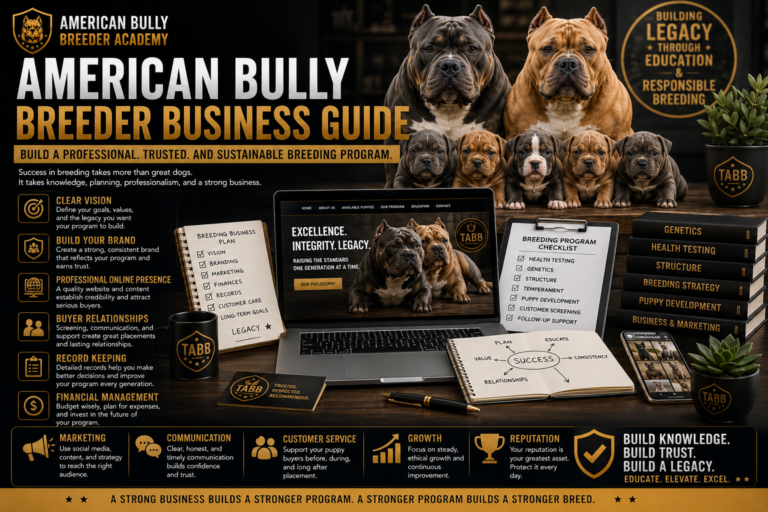
Business: American Bully Breeder Business Academy
Marketing: American Bully Puppy Marketing Academy