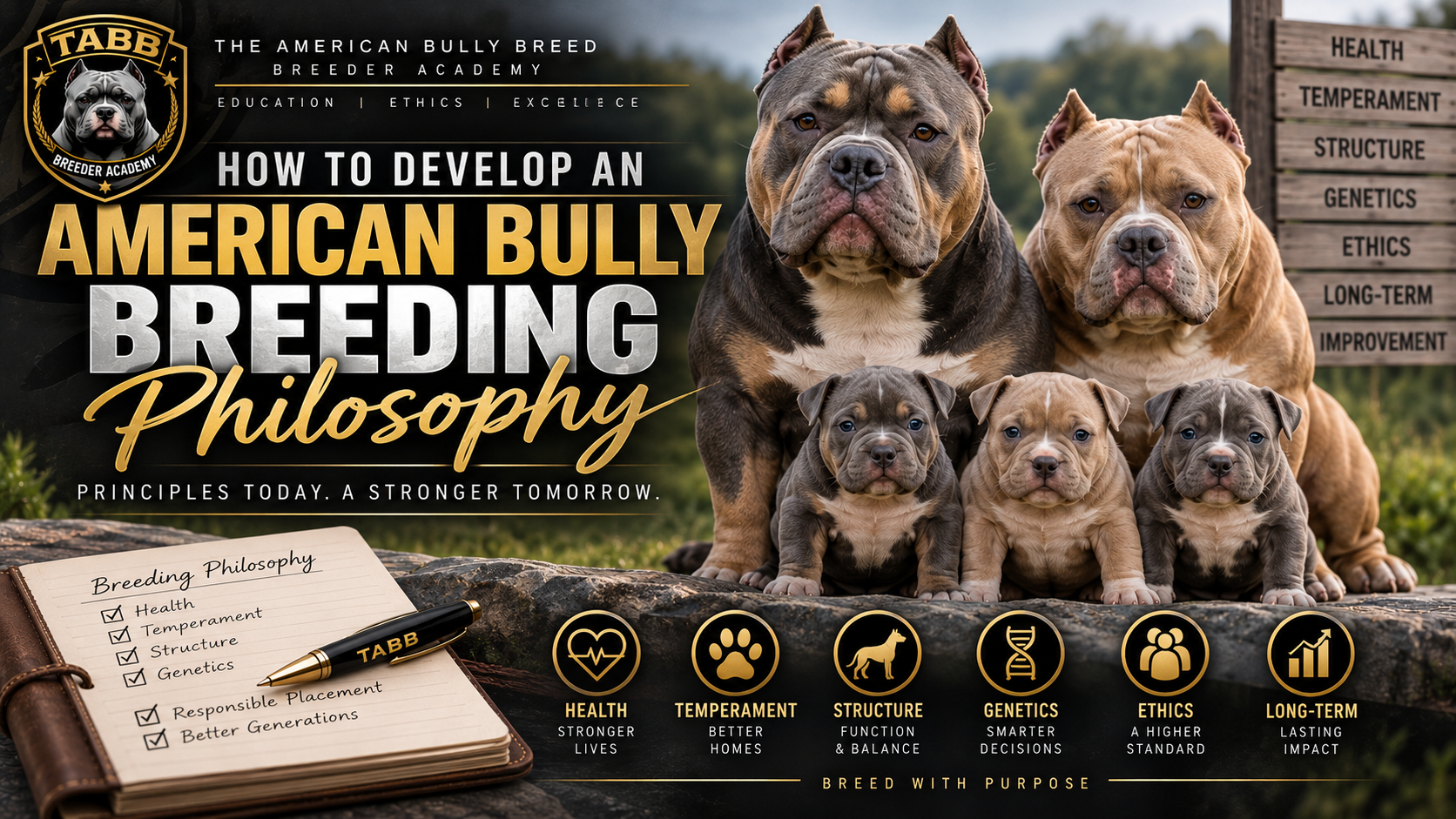
A successful American Bully breeding program should be built around more than producing impressive-looking dogs, following popular bloodlines, or responding to whatever traits happen to be trending.
Strong programs begin with something deeper: a clearly defined breeding philosophy.
Your breeding philosophy establishes what you believe responsible breeding should accomplish, which characteristics deserve priority, where you refuse to compromise, and how individual breeding decisions contribute to the future of your program.
For American Bully breeders, that philosophy should consider health, temperament, structure, breed type, genetics, puppy development, responsible placement, and long-term improvement.
The exact priorities may differ between programs. However, every serious breeder should eventually be able to answer three fundamental questions:
Why am I breeding?
What am I trying to produce?
How will I make decisions that move my program toward that goal?
This guide from the The American Bully Breed Breeder Academy explains how to develop an American Bully breeding philosophy that can guide individual pairings while creating greater consistency across generations.
What Is an American Bully Breeding Philosophy?
An American Bully breeding philosophy is the collection of principles you use to guide breeding decisions.
Think of your breeding goals as the destination and your breeding philosophy as the framework you use to reach it.
A breeder might establish goals such as:
- Improving structural balance
- Producing more predictable temperaments
- Maintaining recognizable American Bully breed type
- Reducing avoidable health risks
- Improving consistency between generations
- Developing a recognizable family of dogs
Your philosophy determines how you pursue those goals.
For example, one breeder may establish that health and functional structure will never be sacrificed simply to produce increasingly exaggerated physical characteristics.
Another may determine that stable temperament carries equal importance to appearance when selecting breeding stock.
Those principles become filters through which future breeding decisions are evaluated.
If you haven’t established your program’s goals yet, begin with How to Set Goals for an American Bully Breeding Program before developing the philosophy that will guide you toward them.
Why Every American Bully Breeding Program Needs a Philosophy
Without clearly established principles, breeding programs can easily become reactive.
A breeder sees a popular stud and changes direction.
A particular color becomes desirable and suddenly becomes the priority.
A certain physical characteristic gains attention online and becomes increasingly exaggerated.
A famous bloodline becomes popular, so breeders begin incorporating it without determining whether it actually complements their existing dogs.
One generation can eventually look completely different from the next.
Over time, the breeding program loses direction.
A breeding philosophy creates consistency because decisions are measured against established principles rather than short-term popularity.
Before making an important breeding decision, ask:
Does this decision move my program toward the type of American Bully I am trying to produce?
If the answer is no, popularity alone shouldn’t change the decision.
Start With the Purpose of Your Breeding Program
Before deciding which characteristics to prioritize, establish why your breeding program exists.
Ask yourself:
What do I ultimately want my program to contribute to the American Bully?
The answer should extend beyond producing puppies.
Perhaps your objective is to develop American Bullies recognized for balanced structure, stable family temperament, and consistent breed type.
Perhaps you are developing a particular family of dogs while preserving desirable characteristics across generations.
Perhaps your program focuses on smaller American Bullies while refusing to allow reduced size to take priority over health and functional structure.
Whatever direction you choose, your purpose should be clear enough to influence decisions years into the future.
A breeding purpose might read:
Our program exists to produce healthy, structurally balanced American Bullies with stable temperaments, recognizable breed type, and predictable characteristics while making responsible breeding decisions intended to strengthen each generation.
Your statement doesn’t need to sound impressive.
It needs to help you make decisions.
Build Your Breeding Philosophy Around Core Priorities
A complete breeding philosophy should consider several interconnected areas.
None exists completely independently of the others.
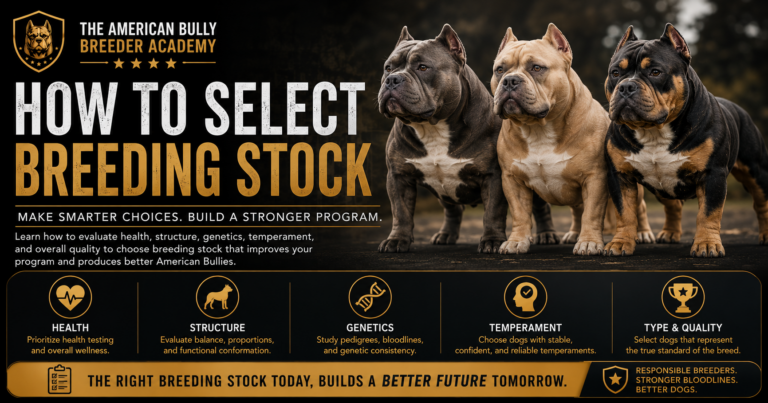
1. Put Health at the Foundation
Health should be one of the foundations of responsible breeding.
Breeding decisions should consider more than whether a dog appears healthy.
Depending on the dogs and breeding program, breeders may evaluate available health information, family history, genetic risks, veterinary findings, DNA results, and appropriate health screening before making breeding decisions.
Testing cannot guarantee that every puppy will remain healthy throughout its lifetime. Instead, it gives breeders additional information that can help them make more informed decisions.
The TABB Health & Testing Academy provides deeper education about health screening, genetic testing, preventative health, and responsible breeding decisions.
You can also continue with Health Testing for American Bullies: A Breeder’s Guide to begin developing a health-testing strategy for your program.
2. Define the Temperament You Want to Produce
Temperament should never become an afterthought.
American Bullies frequently live closely with people and families. A breeder therefore needs to think seriously about behavioral characteristics when evaluating breeding stock.
Characteristics to consider can include:
- Confidence
- Sociability
- Emotional stability
- Trainability
- Appropriate responses to unfamiliar situations
- Ability to recover from stress
- Human interaction
- Overall predictability
A physically impressive dog with undesirable temperament characteristics may not represent the direction you want to reproduce.
Your philosophy should establish what temperament means within your particular breeding program and how much importance it receives when breeding decisions are made.
3. Prioritize Structure and Function Together
Appearance is an important component of American Bully type, but appearance and function shouldn’t be treated as completely separate considerations.
A dog may look impressive standing still while weaknesses become more apparent once the dog begins moving.
Evaluate the whole dog, including:
- Overall balance
- Front assembly
- Rear assembly
- Topline
- Feet
- Pasterns
- Proportions
- Movement
- Stability
- Coordination
The objective shouldn’t automatically be more.
More width.
More bone.
More head.
More mass.
Instead, breeders should understand how individual characteristics work together.
The TABB Structure Academy explores structural evaluation in greater depth.
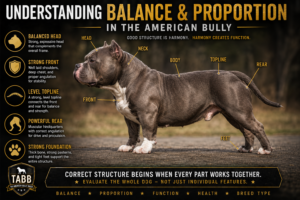
Two important supporting guides are Understanding Balance and Proportion in the American Bully and Common Structural Faults in American Bullies: A Breeder’s Guide.
Together, these resources can help breeders move beyond evaluating individual features and begin looking at the dog as a complete structural system.
4. Preserve Breed Type Without Chasing Exaggeration
Breed type matters.
An American Bully should possess characteristics that make it recognizable as an American Bully.
However, breeders should learn to distinguish between strong breed type and unnecessary exaggeration.
This distinction becomes especially important when breeding heavily built dogs or breeding toward smaller sizes.
Before selecting heavily for a characteristic, ask:
Does this characteristic contribute positively to the dog?
Is it structurally sustainable?
Could increasing this trait create problems elsewhere?
Am I selecting this because it improves my program—or because it currently receives attention?
A responsible breeding philosophy establishes limits.
Knowing what you refuse to breed toward can be just as valuable as knowing what you want.
5. Treat Genetics and Pedigrees as Information
A pedigree should be more than a collection of recognizable kennel names and famous dogs.
It is part of the genetic history behind the dog in front of you.
Responsible breeders should study what families of dogs have historically produced, including their strengths and weaknesses.
That may include:
- Trait consistency
- Health history
- Structural tendencies
- Temperament
- Size
- Breed type
- Reproductive history
- Recurring faults
- Characteristics appearing across generations
The objective isn’t simply to combine two impressive pedigrees.
The breeder should understand why the genetic combination makes sense for the program.
The TABB Genetics Academy provides a foundation for understanding inheritance, bloodlines, genetic principles, and breeding strategy.
Decide Which Traits Are Non-Negotiable
Not every desirable characteristic deserves equal weight.
One practical approach is separating your priorities into three categories.
Non-Negotiable Traits
These are standards that breeding prospects should meet before you seriously consider incorporating them into the program.
Your standards might include acceptable temperament, health considerations, functional movement, and minimum structural requirements.
Improvement Traits
These are characteristics you are actively trying to strengthen within your program.
Examples could include:
- Stronger feet
- Better rear construction
- Improved toplines
- Greater structural balance
- More consistent head type
- Increased temperament consistency
Preference Traits
These are characteristics you like but which shouldn’t override more important considerations.
Color is a useful example.
You may prefer a particular color or pattern. But that preference shouldn’t automatically outweigh health, temperament, structure, genetic compatibility, or the long-term direction of the breeding program.
Creating this hierarchy helps prevent secondary characteristics from controlling primary breeding decisions.
Evaluate Your Dogs Honestly
Developing a breeding philosophy requires objectivity.
Every dog has strengths and weaknesses.
The challenge is evaluating both without allowing emotional attachment, purchase price, pedigree, reputation, social-media popularity, or previous investment to distort the assessment.
For each breeding prospect, evaluate four areas.
Strengths
Which characteristics would you like to preserve?
Weaknesses
What should ideally be improved?
Risks
Which weaknesses could become more pronounced through a particular pairing?
Compatibility
Does the potential mate genuinely complement the dog?
The objective isn’t finding a perfect American Bully.
It is making informed pairings with defined purposes.
Don’t Breed Two Dogs Simply Because You Like Both
One of the most valuable principles a breeder can establish is:
Every pairing should have a reason.
Owning two excellent dogs doesn’t automatically mean those two dogs belong together.
Before a breeding occurs, you should be able to explain what you expect the pairing to accomplish.
For example:
The female demonstrates excellent temperament, strong breed type, and good overall balance but could benefit from tighter feet and improvement in the rear. The male demonstrates those characteristics consistently and comes from a family showing similar strengths.
Now there is a defined purpose behind the pairing.
Compare that with:
They’re both great dogs with excellent pedigrees.
That tells you very little about how the pairing contributes to the breeding program.
Think in Generations, Not Litters
This is one of the most important mindset changes in program development.
A litter is an event.
A breeding program is a multi-generational project.
Before planning a pairing, think beyond the immediate puppies.
Ask:
- Which puppies might become future breeding prospects?
- What characteristics should those prospects carry forward?
- What would I want to improve in the following generation?
- Does this pairing create useful future options?
- Am I creating consistency or repeatedly changing direction?
- How does this litter fit into my long-term plan?
The process should resemble:
Vision → Pairing → Litter → Evaluation → Selection → Next Generation → Evaluation → Improvement
Each generation gives you information.
Use that information to guide the next one.
This long-term thinking is a central part of the TABB Program Development Academy.
Keep Records of What Your Program Actually Produces
Memory isn’t enough for serious program development.
Maintain breeding records that allow you to evaluate patterns over time.
Depending on your program, you might track:
- Litter size
- Birth weights
- Puppy development
- Adult size
- Structural development
- Temperament
- Health observations
- Color and pattern
- Bite
- Movement
- Reproductive performance
- Veterinary findings
- Buyer feedback
Photographs and videos taken at consistent developmental stages can become particularly valuable.
Over several generations, patterns may begin to appear.
That information allows breeders to gradually replace assumptions with documented program knowledge.
Include Puppy Development in Your Breeding Philosophy
Your responsibility doesn’t stop when the puppies are born.
Early development can influence how puppies adapt to their future environments.
A complete breeding philosophy should therefore address areas such as:
- Neonatal care
- Nutrition
- Handling
- Environmental exposure
- Socialization
- Confidence building
- Early training foundations
- Health monitoring
- Preparing puppies for new homes
The TABB Puppy Development Academy focuses on raising confident, healthy American Bully puppies from birth through placement.
Producing genetically promising puppies is only part of the breeder’s responsibility.
Those puppies also need a strong beginning.
Make Responsible Puppy Placement Part of the Philosophy
Breeding philosophy should include the people who eventually own your puppies.
Not every puppy belongs in every home.
Establish standards for:
- Buyer applications
- Puppy matching
- Contracts
- Health information
- Feeding guidance
- Training education
- Transportation or pickup
- Follow-up communication
- Long-term breeder support
The puppies you place eventually become representatives of your breeding program.
Responsible placement is therefore not separate from program development.
It is part of it.
Ethical Puppy Marketing Should Reflect Your Breeding Philosophy
Marketing is another extension of breeder philosophy.
Responsible marketing should accurately represent the puppies and breeding program rather than relying on misleading claims, artificial urgency, or exaggerated promises.
Breeders should clearly communicate relevant information such as puppy age, sex, availability, parent information, location, breeder policies, and appropriate health information.
The TABB Puppy Marketing Academy teaches breeders how to develop visibility, create professional content, reach prospective buyers, and market puppies while maintaining responsible standards.
As TABB’s marketplace resource, Bully Puppy Market (BPM) is being developed specifically around the American Bully puppy market, giving breeders another potential channel for connecting their puppies with prospective buyers.
A dedicated marketplace should be viewed as one component of a diversified marketing strategy, alongside breeder websites, educational content, referrals, search visibility, and appropriate social-media marketing.
Bully Puppy Market.
This is the strongest location for the BPM banner because the transition from responsible placement → ethical marketing → marketplace exposure is completely natural.
Don’t Let Trends Rewrite Your Philosophy
American Bully trends can change quickly.
Certain colors become popular.
Specific bloodlines receive attention.
New terminology appears.
Particular physical characteristics gain social-media visibility.
A breeding philosophy helps prevent your entire program from changing every time the market changes.
That doesn’t mean a breeding program should never evolve.
It should.
But meaningful change should occur because experience, evidence, health information, evaluation, or improved knowledge points toward a better direction.
Not simply because something different is receiving attention online.
Allow Your Breeding Philosophy to Evolve
A philosophy should provide stability without becoming rigid.
As breeders gain experience, they often discover that some early assumptions were incomplete.
Health information may change.
A bloodline may produce differently than expected.
A structural characteristic may prove more important than originally believed.
Buyer feedback may reveal temperament patterns.
Keeping puppies into adulthood may expose characteristics that weren’t obvious at eight weeks.
Responsible breeders learn from those outcomes.
A strong philosophy can therefore be summarized as:
Firm principles. Flexible strategy. Continuous learning.
Put Your American Bully Breeding Philosophy in Writing
Once you’ve considered these areas, write your philosophy down.
It doesn’t need to be long.
For example:
Our breeding philosophy is to produce American Bullies that combine health, stable temperament, balanced structure, recognizable breed type, and long-term consistency. We select breeding stock based on the contribution each dog can make to future generations rather than individual appearance alone. Every pairing should have a defined purpose, and every generation should provide information that helps us improve the next.
Then actually use it.
Review your philosophy when selecting breeding stock.
Review it when choosing a stud.
Review it when evaluating a keeper puppy.
Review it when considering a new bloodline.
Review it when a popular trend tempts you to change direction.
If your breeding philosophy never changes a breeding decision, it is little more than marketing copy.
From Breeding Philosophy to Breeding Strategy
Developing your philosophy is not the end of program development.
It’s the foundation for what comes next.
The progression should look something like this:
What you believe
↓
What you want to produce
↓
What your current dogs offer
↓
What needs improvement
↓
Which pairings move you closer
↓
Which offspring should be retained
↓
What the next generation should accomplish
This is where a collection of dogs begins becoming an actual breeding program.
Continue through the American Bully Program Development Academy to build each stage systematically.
Final Thoughts: Breed With Purpose
The strongest American Bully breeding programs aren’t built around a single dog, litter, color, bloodline, or social-media trend.
They’re built around principles repeated across generations.
Know why you breed.
Define what matters.
Understand your dogs.
Recognize weaknesses.
Use health information.
Evaluate structure and temperament.
Study pedigrees.
Track outcomes.
Place puppies responsibly.
Make every pairing purposeful.
Then learn from what your program produces.
A breeder cannot control every genetic outcome.
But a breeder can control the quality and purpose of the decisions leading to each breeding.
That is where an American Bully breeding philosophy becomes valuable.
Continue Through the TABB Program Development Academy
← Previous: How to Set Goals for an American Bully Breeding Program
Academy Home: American Bully Program Development Academy
Related: American Bully Genetics Academy
Related: American Bully Structure Academy
Related: American Bully Health & Testing Academy
Related: American Bully Puppy Development Academy
Marketing: American Bully Puppy Marketing Academy
Next Article:
How to Build a Long-Term American Bully Breeding Strategy
Set Goals → Develop a Philosophy → Build a Long-Term Strategy → Select Breeding Stock → Plan Pairings → Evaluate Results → Improve the Next Generation.