Building a successful American Bully breeding program begins long before choosing a stud, purchasing a female, or planning a first litter.
It begins with a question:
What are you trying to produce?
Without a clear answer, breeding decisions can quickly become reactive. A breeder may purchase dogs because of popular bloodlines, choose studs because they are trending on social media, focus heavily on color, or make pairings simply because two impressive dogs are available.
Those decisions may produce puppies—but they do not necessarily build a breeding program.
A breeding program requires direction.
The strongest programs are developed around clearly defined goals that influence breeding-stock selection, health testing, pedigree research, structural evaluation, puppy selection, future pairings, and long-term program development.
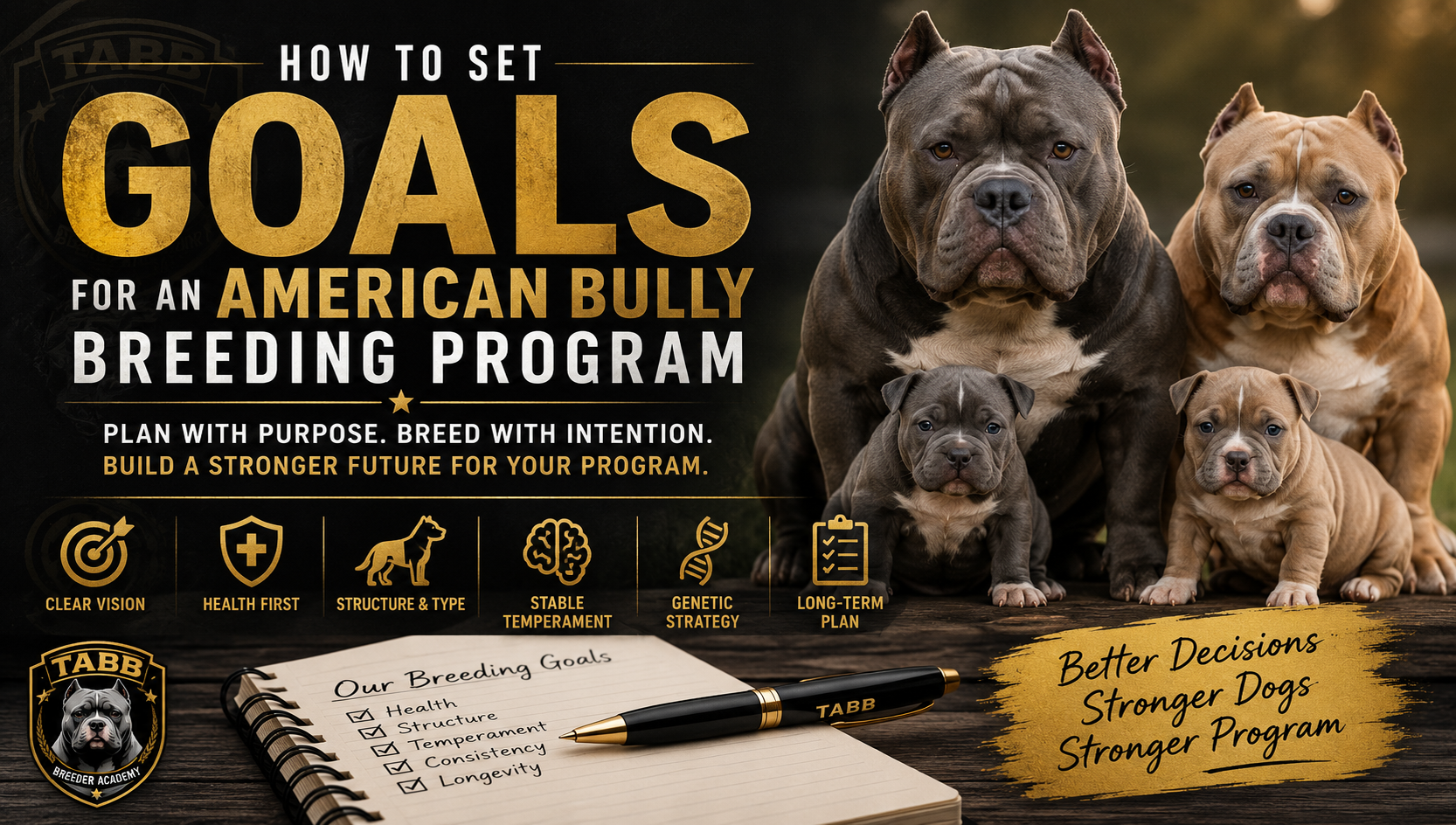
This guide from The American Bully Breed (TABB) Breeder Academy explains how to establish meaningful breeding goals and use those goals to guide your program across multiple generations.
Why Breeding Program Goals Matter
A breeding goal provides a standard against which future decisions can be measured.
Instead of asking:
“Do I like this dog?”
a breeder begins asking:
“Does this dog help move my program toward its goals?”
Instead of:
“Is this a popular stud?”
the question becomes:
“Does this stud complement my female and contribute characteristics my program needs?”
That change in thinking is significant.
It moves breeding decisions away from short-term preferences and toward long-term program development.
The American Bully Program Development Academy explores this broader concept: successful programs are developed through connected decisions made across generations.
Goals provide the direction for those decisions.
1. Decide What You Want Your Program to Represent
Start by imagining your breeding program several years from now.
When someone sees a dog produced by your program, what characteristics would you want them to recognize?
Perhaps you want your program associated with:
- Balanced structure
- Correct breed type
- Functional movement
- Stable temperament
- Health
- Consistency
- Predictable size
- Strong head type
- Proper proportions
- Family suitability
- Longevity
There is no need to select every possible characteristic.
In fact, trying to improve everything simultaneously can make program development more difficult.
Identify the characteristics that matter most to the type of American Bully you are trying to produce.
2. Define Your American Bully Type
Breeders should have a clear understanding of the type of American Bully they intend to develop.
Size alone is not enough.
Consider the complete dog.
Ask yourself:
What overall appearance am I trying to establish?
What proportions should define my dogs?
How much bone and substance am I seeking?
What head type do I prefer?
What type of movement should my dogs demonstrate?
What temperament should characterize my puppies?
What characteristics must never be sacrificed simply for appearance?
The more clearly you can describe your ideal dog, the easier it becomes to evaluate whether potential breeding stock fits the program.
3. Put Health Among Your Core Goals
Health should never be treated as something separate from breeding-program development.
It is part of the foundation.
A breeder’s health goals might include:
- Appropriate genetic testing
- Orthopedic evaluations
- Cardiac screening
- Veterinary examinations
- Reproductive health
- Tracking health across related dogs
- Maintaining records across generations
- Reducing known health risks where possible
Testing itself is not the ultimate goal.
Using the information to make better breeding decisions is.
The TABB guide to Health Testing for American Bullies explains how health screening can contribute to more informed breeding decisions.
4. Establish Structural Goals
Structure is one of the areas where clearly defined goals become especially valuable.
Simply saying:
“I want better structure”
is too broad.
Determine what that actually means within your program.
You might establish goals involving:
- Front assembly
- Rear assembly
- Topline
- Feet
- Pasterns
- Shoulder placement
- Angulation
- Chest development
- Balance
- Proportion
- Movement
The purpose is not to chase perfection.
No dog is perfect.
The purpose is to understand which characteristics you are trying to preserve and which weaknesses you want to reduce.
Breeders developing their structural evaluation skills should continue through the American Bully Structure Academy and study Understanding Balance and Proportion in the American Bully.
5. Don’t Build Your Goals Around Individual Features
A common mistake is reducing a breeding program to a collection of exaggerated individual traits.
For example:
Bigger head.
More bone.
Wider chest.
Shorter body.
Those characteristics cannot be evaluated responsibly in isolation.
Changing one component of a dog’s structure can affect the overall balance and function of the dog.
Instead of asking:
How can I make this feature more extreme?
ask:
How does this characteristic contribute to the complete dog?
A well-developed breeding goal should focus on the whole dog, not disconnected body parts.
6. Establish Temperament Goals
Temperament deserves the same deliberate attention as appearance.
Ask:
What temperament should characterize dogs produced by my program?
Depending on your program, goals may include dogs that are:
- Confident
- Stable
- Social
- Trainable
- Adaptable
- People-oriented
- Manageable in everyday environments
Temperament has both genetic and environmental influences, which means breeders should evaluate breeding stock while also giving puppies appropriate developmental experiences.
TABB’s American Bully Puppy Development Academy provides the next layer of education on early puppy development.
7. Understand the Genetics Behind Your Goals
Goals tell you where you want to go.
Genetics influence your ability to get there.
Breeders should understand:
- Basic inheritance
- Dominant and recessive traits
- Polygenic characteristics
- Genetic diversity
- Pedigree relationships
- Family consistency
- Health genetics
- Phenotype versus genotype
This is why breeding-program planning and genetics are closely connected.
A breeder cannot simply choose two dogs that visually resemble the desired outcome and assume every characteristic will reproduce predictably.
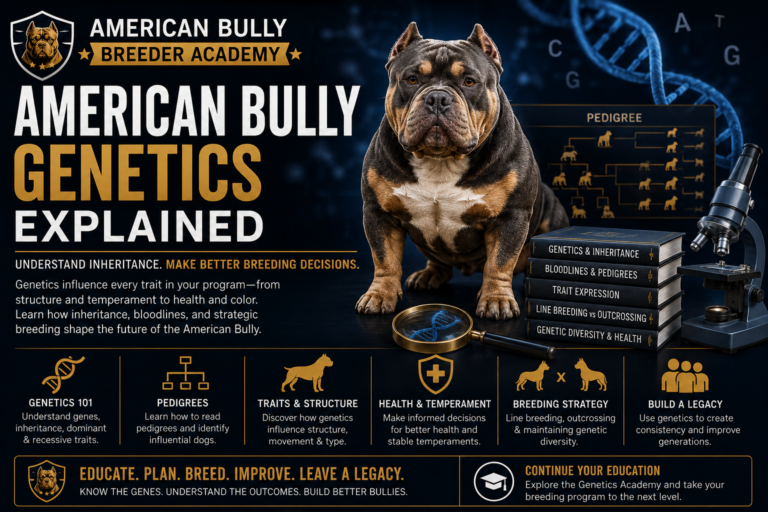
Study American Bully Genetics Explained and American Bully Bloodlines Explained before making genetics a major component of your program strategy.
8. Separate Goals From Trends
One of the biggest threats to long-term program consistency is constantly changing direction.
Social media can make a particular:
- Color
- Bloodline
- Size
- Stud
- Look
- Structural feature
seem essential almost overnight.
Six months later, something else may receive the attention.
If your breeding goals change every time the market changes, establishing consistency becomes extremely difficult.
Before following a trend, ask:
Does this actually contribute to the breeding program I am trying to build?
If the answer is no, popularity alone isn’t a strong enough reason to change direction.
9. Study Your Foundation Dogs Honestly
Once your goals are established, evaluate the dogs already in your program against those goals.
Do not begin by asking what you love about them.
Begin with an objective assessment.
For every potential breeding dog, document:
Strengths
What characteristics do you want to preserve?
Weaknesses
What characteristics should be improved?
Health
What testing and family health information are available?
Temperament
Does the dog’s temperament align with your program objectives?
Pedigree
What traits appear consistently in related dogs?
Production
If the dog has already been bred, what has it actually produced?
Program Fit
Does this dog move the program closer to its long-term goals?
TABB’s How to Select Breeding Stock provides a more detailed framework for evaluating potential breeding dogs.
10. Turn Broad Goals Into Measurable Objectives
A goal such as:
“Produce better American Bullies”
sounds positive, but it doesn’t provide much direction.
Make goals more specific.
Instead of:
Improve structure
consider:
Prioritize balanced front and rear assemblies while maintaining correct proportions and functional movement.
Instead of:
Produce good temperaments
consider:
Select breeding stock displaying stable, confident and manageable temperaments and track temperament feedback from puppy owners.
Instead of:
Improve health
consider:
Establish a consistent health-testing protocol and maintain health records on breeding dogs and produced offspring whenever information is available.
Specific goals make future evaluation easier.
11. Create Short-Term and Long-Term Breeding Goals
Not every objective can be accomplished in one generation.
Separate goals into stages.
Short-Term Goals
These might cover the next one or two breedings.
Examples:
- Improve a particular structural weakness
- Introduce complementary genetics
- Establish health-testing protocols
- Improve record keeping
- Retain a promising puppy
- Evaluate a new bloodline
Medium-Term Goals
These might span several generations.
Examples:
- Increase structural consistency
- Establish more predictable size
- Improve movement across the program
- Strengthen temperament consistency
- Develop a recognizable type
Long-Term Goals
These define the eventual program.
Examples:
- Establish a recognizable family of dogs
- Produce consistent quality across generations
- Develop a respected program reputation
- Preserve desired characteristics
- Reduce recurring weaknesses
- Create a sustainable multi-generation breeding strategy
Thinking this way prevents breeders from expecting a single pairing to accomplish everything.
12. Give Every Breeding a Purpose
Before completing a breeding, write down its objective.
A breeder should be able to explain:
Why this female?
Why this male?
What strengths are we trying to preserve?
What weaknesses are we trying to improve?
What does each dog contribute?
What potential risks exist?
What would make this breeding successful?
How could retained offspring fit into the next generation?
If the only answer is:
“They should make nice puppies,”
the breeding plan needs more development.
Every litter should have a reason for existing within the larger program.
13. Don’t Expect the Stud to Fix Everything
A famous or exceptional stud cannot automatically correct every weakness in a female.
Likewise, an outstanding female cannot guarantee quality puppies from every male.
Pairings should be evaluated based on compatibility, not popularity.
If both dogs carry similar weaknesses, pairing them may reinforce those weaknesses.
Instead, breeders should look for complementary strengths while considering pedigree, genetics, health, temperament and previous production.
That is why breeding goals should be established before selecting the mating.
14. Evaluate Whether Each Litter Reached the Goal
Once puppies are produced, return to the original breeding objective.
Ask:
- Did we improve the targeted characteristic?
- What strengths appeared consistently?
- What weaknesses appeared?
- How uniform was the litter?
- How are the puppies developing?
- Did temperament meet expectations?
- Did anything unexpected appear?
- Which puppies best represent the program goals?
- What should change next time?
This creates a feedback loop:
Goal → Pairing → Litter → Evaluation → Adjustment → Next Goal
Without evaluation, goals become little more than intentions.
15. Track Puppies After They Leave
Some of the most valuable information about a breeding appears months or years after puppies leave.
Encourage owners to provide updates.
Information about:
- Adult size
- Structure
- Temperament
- Health
- Movement
- Development
- Veterinary issues
can help breeders understand what their pairings actually produced.
A puppy that looks exceptional at eight weeks may develop differently as an adult.
Long-term feedback improves future decision-making.
16. Know When to Change a Goal
Consistency doesn’t mean refusing to adapt.
New information may reveal that a goal needs modification.
Perhaps:
- A health concern appears.
- A structural issue becomes more common.
- A bloodline doesn’t produce as expected.
- Adult offspring develop differently than anticipated.
- Temperament needs greater emphasis.
- A particular strategy isn’t improving consistency.
Responsible breeders adjust based on evidence.
The important distinction is between strategic adjustment and constantly chasing trends.
One is program development.
The other is changing direction without a plan.
17. Know When a Dog No Longer Fits the Program
This can be one of the hardest decisions breeders face.
A dog may have been purchased specifically for breeding.
A puppy may have been retained for years.
Plans may already exist.
But if the dog ultimately does not meet the program’s standards because of health, structure, temperament, development or other significant concerns, the breeder should be willing to reconsider those plans.
The question should remain:
Does breeding this dog move the program toward our goals?
Previous investment should not determine future genetic decisions.
18. Create a Written Breeding Program Plan
Your program goals should not exist only in your head.
Create a written plan.
A basic program-development document can include:
Program Mission
What does your breeding program stand for?
Desired Type
What should your ideal American Bully look and function like?
Health Goals
What testing and tracking will you use?
Structural Goals
Which strengths will you preserve and weaknesses will you address?
Temperament Goals
What behavioral qualities are priorities?
Genetic Strategy
How will pedigree and genetic information influence pairings?
Selection Criteria
What qualifies a dog to remain in the breeding program?
Puppy Evaluation
How will litters and potential keepers be evaluated?
Long-Term Vision
Where should the program be in five or ten years?
This document can evolve as your knowledge and program develop.
19. Your Goals Should Eventually Create Program Identity
Over time, consistent selection should make your breeding program recognizable.
People should begin associating your program with particular qualities.
That might be:
Structure.
Temperament.
Consistency.
Health-conscious breeding.
A recognizable type.
Professionalism.
That identity shouldn’t be manufactured through marketing.
It should develop because your dogs consistently demonstrate what your program claims to prioritize.
Then marketing communicates the reality.
20. Build the Program Before Marketing the Program
This is an important principle as breeders progress through the TABB Breeder Academy.
Marketing should amplify a breeding program—not substitute for one.
The correct progression is:
Education → Goals → Breeding Strategy → Quality → Consistency → Reputation → Marketing
Once a breeder has established a program worth representing, professional marketing can help responsible buyers discover it.
That is where TABB’s Puppy Marketing Academy fits into the breeder-development journey.
Breeders can learn how to present their programs professionally, create better puppy listings, build buyer trust, and use appropriate channels to reach prospective homes.
From Program Goals to Puppy Placement
Eventually, the goals established in a breeding program become visible in the puppies produced.
Those puppies need responsible homes.
Breeders should therefore think about puppy placement as an extension of program development—not simply the final sale.
A breeder’s reputation follows the puppies after they leave.
The homes chosen, buyer education provided, support offered and transparency shown all become part of the program’s long-term identity.
Featured Breeder Marketplace Resource: Bully Puppy Market
As breeders develop their programs, they also need appropriate ways to connect available puppies with prospective buyers.
Bully Puppy Market (BPM) is being developed as a dedicated marketplace for American Bully puppies, connecting responsible breeders with buyers actively searching for the breed.
For breeders building their visibility, BPM provides another way to present their puppies and breeding programs beyond their own websites and social media audiences.
LIST YOUR PUPPIES FOR FREE
Breeders can use BPM to increase the visibility of available puppies while maintaining their individual program identity.
Build your program → produce responsibly → present your program → list your puppies.
Your Breeding Goals Should Outlast Individual Dogs
Dogs enter and leave breeding programs.
Bloodlines evolve.
New generations replace previous ones.
But the program’s underlying purpose should continue.
That’s the difference between owning breeding dogs and developing a breeding program.
Your foundation dog may begin the journey.
Your next generation may improve it.
Later generations may create greater consistency.
Eventually, the program becomes recognizable independently of any single dog.
That is what long-term breeding goals are designed to accomplish.
A Simple Goal-Setting Framework for American Bully Breeders
Before planning your next breeding, complete these statements:
My breeding program exists to:
The American Bully type I want to produce is:
The three characteristics I most want to preserve are:
The three areas I most want to improve are:
My primary health objectives are:
My temperament objectives are:
My next breeding should accomplish:
The puppy I retain should contribute:
Within five years, I want my program to be known for:
Save your answers.
Then return to them before making major breeding decisions.
Continue Your Program Development Education
Setting goals is only the beginning.
Continue building the knowledge required to turn those goals into a multi-generation breeding strategy.
Program Development Academy
Return to the American Bully Program Development Academy to continue building your long-term breeding strategy.
Genetics
Study American Bully Genetics Explained to better understand how inheritance affects your ability to achieve breeding goals.
Breeding Stock
Learn How to Select Breeding Stock based on program objectives rather than individual popularity.
Structure
Continue through the American Bully Structure Academy to strengthen your ability to evaluate breeding dogs.
Health
Review Health Testing for American Bullies and incorporate health information into your program-development strategy.
Responsible Breeding
Read Responsible American Bully Breeding for the broader principles that should guide breeding decisions.
Final Thoughts: Know Where You’re Going Before You Start Breeding
The strongest breeding programs don’t happen accidentally.
They begin with a vision.
That vision becomes a set of goals.
Those goals guide breeding-stock selection.
Selection guides pairings.
Pairings create generations.
Generations create consistency.
And consistency eventually creates a recognizable breeding program.
Before asking:
“Which dog should I breed next?”
ask the more important question:
“What am I trying to build?”
When that answer becomes clear, many of the decisions that follow become clearer as well.
Define your goals. Breed with purpose. Evaluate honestly. Improve every generation. Build for the future.
The American Bully Breed Breeder Academy — Education. Ethics. Excellence.