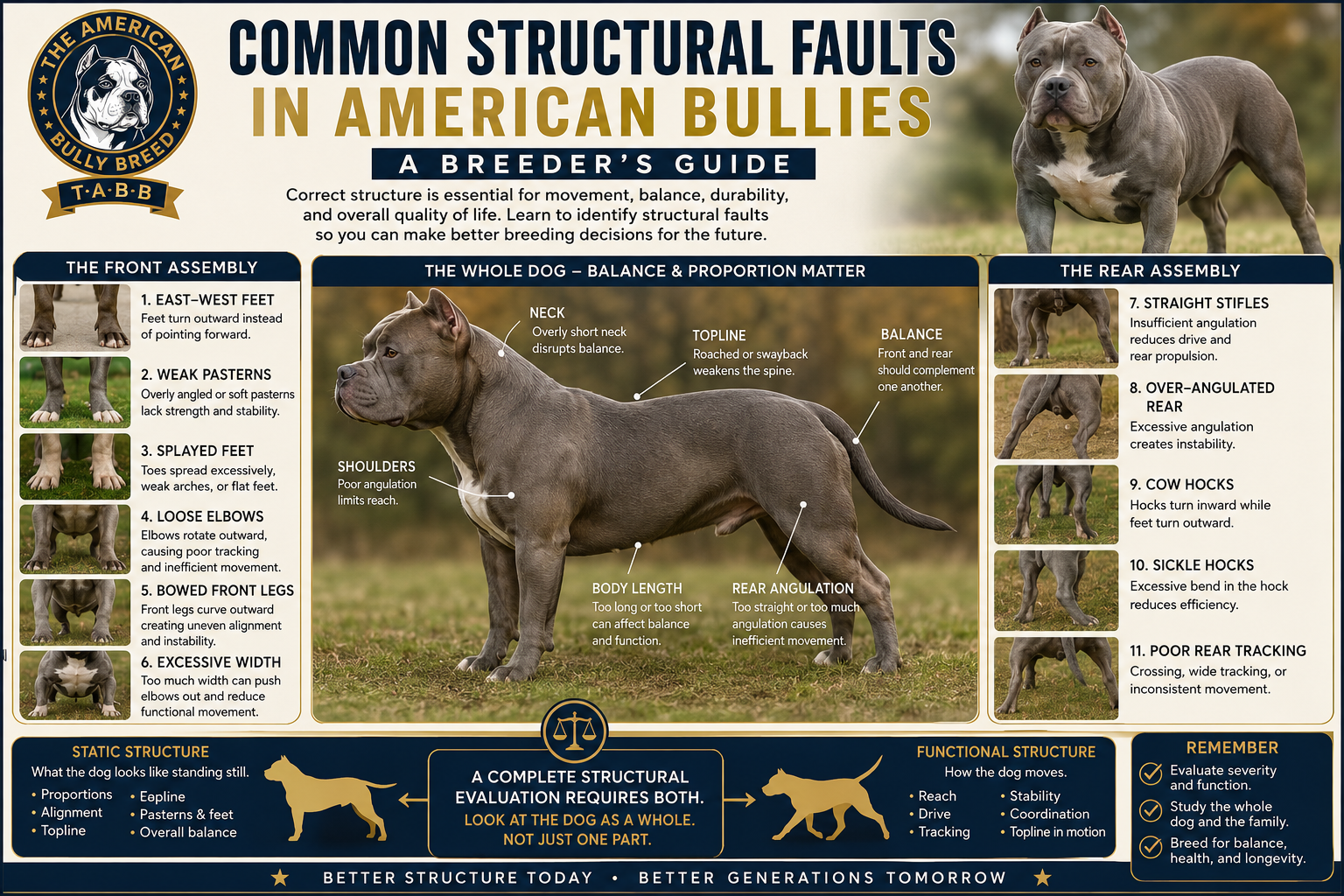
American Bully structure is about far more than producing an impressive-looking dog. Correct structure influences movement, balance, physical comfort, durability, breeding decisions, and overall breed quality.
For responsible breeders, learning to recognize structural weaknesses is an essential part of selecting breeding stock and planning future generations.
A dog may have an impressive pedigree, dramatic headpiece, desirable color, heavy bone, or substantial muscle, but those characteristics should never overshadow fundamental structural soundness.
Breeders who want a stronger foundation in evaluating anatomy, movement, and proportions should begin with the American Bully Structure Academy, which brings TABB’s structure education together in one central resource.
This guide examines some of the most common structural faults seen in American Bullies, explains why they matter, and shows how responsible breeders can use structural evaluation to make better long-term breeding decisions.
Breeder Principle: The goal should never be exaggeration for its own sake. The goal is a balanced American Bully that combines recognizable breed type with functional structure.
What Is a Structural Fault in an American Bully?
A structural fault is a deviation from desirable anatomical construction that may affect a dog’s balance, movement, stability, appearance, or ability to function efficiently.
Not every imperfection carries the same significance.
Some deviations are relatively minor. Others may interfere with movement or alter how forces are distributed through the limbs, joints, and supporting structures.
This is why breeders should evaluate faults according to their severity, consistency, and functional impact rather than simply counting imperfections.
Structural evaluation should consider the dog as a complete system.
The:
- head
- neck
- shoulders
- front assembly
- spine
- topline
- chest
- rear assembly
- legs
- pasterns
- feet
must all work together.
A weakness in one area can influence movement throughout the rest of the body.
This whole-dog approach is also central to responsible American Bully breeding, where structure should be evaluated alongside health, temperament, genetics, and long-term welfare.
Why Structure Matters in an American Bully Breeding Program
Responsible breeding requires looking beyond what is immediately impressive.
Correct structure contributes to several important aspects of the dog.
Movement
Properly aligned limbs and balanced front and rear assemblies help a dog move efficiently.
Balance
The head, front, body, and rear should complement one another rather than appearing like separate pieces.
Joint Loading
Poor alignment can change how force travels through the limbs during standing, walking, running, and play.
Physical Durability
Balanced construction provides a stronger foundation for normal everyday activity.
Breed Type
Structure contributes significantly to the recognizable appearance of the American Bully.
Future Generations
Breeding decisions can reinforce desirable characteristics, but they can also reinforce structural weaknesses.
That is why breeders should evaluate structure in combination with American Bully genetics, pedigree information, health screening, temperament, and the strengths and weaknesses found throughout a dog’s family.
For an even deeper look at how all parts of the dog should work together visually and functionally, read Understanding Balance and Proportion in the American Bully.
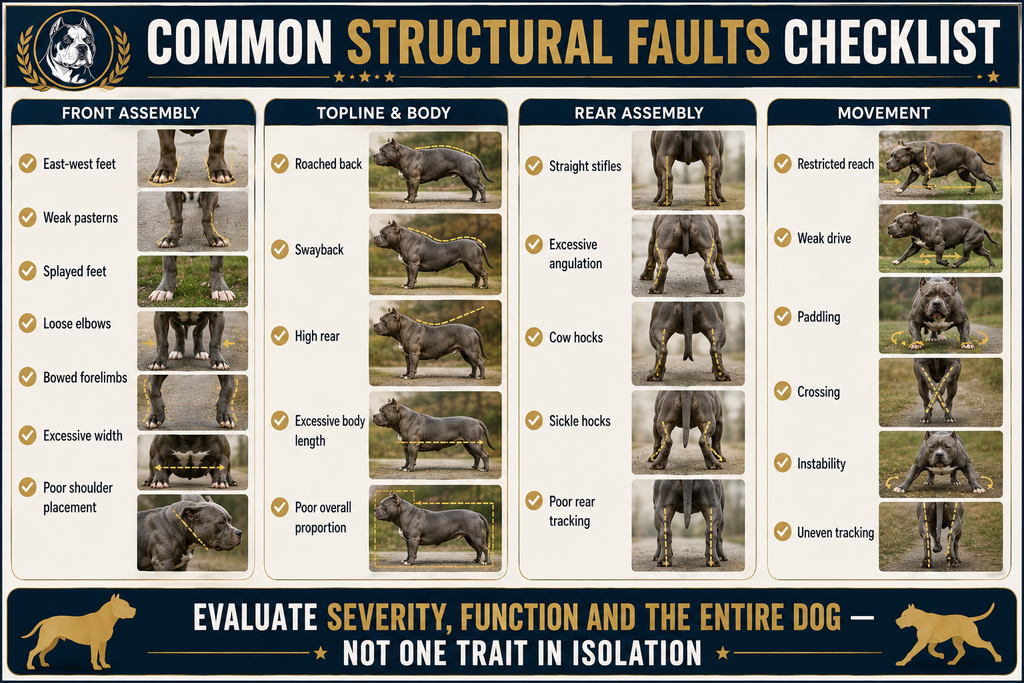
1. East-West Front Feet
One of the more recognizable structural issues in American Bullies is an east-west front, where the front feet rotate outward rather than pointing primarily forward.
A slight outward turn can occur in some dogs and should not automatically be treated as a severe structural problem.
The concern becomes greater when the rotation is pronounced or accompanied by poor alignment higher in the limb.
Breeders should look beyond the feet themselves and evaluate the:
- shoulders
- elbows
- forearms
- wrists
- pasterns
- feet
A turned-out foot can sometimes be the visible result of alignment elsewhere in the front assembly.
Why It Matters
More significant deviations can affect the way the front limbs absorb and distribute force during movement.
Instead of asking only:
“Are the feet straight?”
breeders should ask:
“Is the entire front assembly correctly aligned and functioning together?”
2. Weak Pasterns
The pastern connects the lower portion of the front limb to the foot and contributes to shock absorption.
Healthy pasterns should provide some flexibility while maintaining sufficient strength and stability.
Weak pasterns may appear:
- excessively angled
- soft
- unstable
- dropped toward the ground
Puppies can temporarily appear softer in the pasterns during certain stages of development, which is why breeders should be cautious about making permanent judgments from a single growth stage.
Persistent weakness in a mature dog deserves greater attention.
When evaluating a breeding prospect, observe pastern strength while the dog is standing naturally and moving.
3. Splayed or Flat Feet
A strong foot generally appears compact and well supported.
Splayed feet occur when the toes spread excessively instead of remaining relatively tight and supported.
Poor foot structure can include:
- widely separated toes
- flattened feet
- weak arches
- long or poorly supported toes
Feet are sometimes overlooked because breeders naturally focus on more dramatic characteristics such as the head, chest, bone, and muscle.
But the feet are literally the dog’s foundation.
Poor foundations can influence the stability of everything above them.
4. Loose or Outward Elbows
When viewed from the front, the elbows should work in reasonable alignment with the body and forelimbs.
Excessively loose or outward-turning elbows can disrupt the front assembly.
Possible signs include:
- elbows rotating away from the body
- paddling during movement
- inconsistent front tracking
- excessive outward movement of the forelimbs
Elbow position should never be evaluated independently.
Chest width, shoulder placement, upper-arm construction, and limb alignment all influence the appearance and function of the front assembly.
5. Bowed Front Legs
American Bullies are expected to possess substantial bone and a powerful appearance, but heavy bone should never be confused with distorted limb alignment.
When viewed from the front, the limbs should provide a stable foundation beneath the body.
Pronounced bowing can create uneven alignment from the elbow through the wrist and foot.
This is an important area where breeders need to distinguish breed type from exaggeration.
Extreme width is not automatically better structure.
Attempting to produce increasingly wide fronts without considering skeletal alignment can encourage exaggeration rather than improvement.
Width should come from correct anatomy—not structural distortion.
6. Narrow Front Assembly
The opposite extreme can also be undesirable.
An American Bully should possess the substantial, powerful appearance associated with the breed. A very narrow front can detract from overall breed type and balance.
However, breeders should not attempt to correct narrowness simply by selecting for increasingly extreme width.
The objective should be:
appropriate chest development + correct limb placement + balanced proportions.
7. Excessively Wide Fronts
A broad chest is one of the American Bully’s recognizable characteristics.
But width becomes counterproductive when the front assembly is pushed beyond functional proportions.
An excessively wide front may contribute to:
- elbows being displaced outward
- inefficient movement
- abnormal limb positioning
- imbalance between the front and rear
- reduced functional movement
The question breeders should ask is not:
“How wide can I make this dog?”
Instead, ask:
“Does this width remain structurally balanced and functional?”
That distinction becomes especially important when evaluating compact and heavily built dogs.
8. Poor Shoulder Angulation
The shoulder assembly plays an important role in front movement.
A poorly constructed shoulder can restrict reach and change how the forelimbs move.
Breeders should evaluate the relationship between the:
- shoulder blade
- upper arm
- elbow
- chest
- forelimb
Dogs with inadequate front angulation may take shorter steps or compensate elsewhere in the body.
Because American Bullies can carry substantial muscle, musculature may sometimes make underlying skeletal relationships more difficult to evaluate visually.
That makes hands-on structural evaluation especially valuable.
9. Short Upper Arm
The upper arm connects the shoulder to the elbow and is an important component of the front assembly.
An excessively short or poorly positioned upper arm can restrict forward reach and influence elbow placement.
A breeder examining only the dog’s chest and shoulders from the front can easily overlook this relationship.
That is why structural evaluation should always include the side profile and movement.
10. Roached Back
A roached topline occurs when the back rises excessively upward rather than maintaining an appropriate profile.
Minor variations in topline should not automatically be treated as serious faults. The concern is a persistent or pronounced arch that disrupts overall balance.
Breeders should evaluate the topline:
- while the dog stands naturally
- during movement
- from the side
- at different developmental stages
Puppies can temporarily appear awkward while growing, so age and developmental stage should always be considered.
11. Swayback
A swayback is characterized by an excessive downward dip through the back.
Several factors can influence the appearance of the topline, including:
- structure
- conditioning
- body condition
- age
- developmental stage
For breeding evaluation, persistent topline weakness deserves attention because the spine forms the structural bridge between the front and rear assemblies.
A stable topline helps transfer movement efficiently through the body.
12. High Rear
A dog is described as high in the rear when the hindquarters appear noticeably higher than the front.
This can occur temporarily during puppy development as different portions of the skeleton grow at different rates.
Persistent high-rear structure in a mature dog, however, may affect overall balance.
This is another reason breeders should avoid judging a young puppy as though its adult proportions are already established.
13. Straight Stifles
The stifle is roughly comparable to the human knee and forms an important part of the rear assembly.
A rear with insufficient angulation can appear overly straight.
This may contribute to:
- shorter rear stride
- reduced flexibility
- less efficient propulsion
- imbalance with the front assembly
Rear angulation should complement the front.
A heavily angled rear paired with a very straight front—or the reverse—can result in inefficient movement even when each end looks impressive when viewed separately.
14. Over-Angulated Rear
More angulation is not automatically better.
Excessive rear angulation can create instability and imbalance.
Possible signs include:
- overly bent rear legs
- excessive extension behind the body
- difficulty maintaining stable positioning
- imbalance between front and rear assemblies
The objective should be functional angulation appropriate to the dog’s complete construction, rather than pursuing an extreme outline.
15. Cow Hocks
Cow hocks occur when the rear hocks angle inward toward one another while the feet rotate outward.
Mild variation should be distinguished from pronounced structural deviation.
When significant, cow-hocked alignment can affect rear stability and tracking.
Evaluate the dog:
- standing naturally
- moving away from you
- moving toward you
- moving from the side
Movement frequently reveals weaknesses that a carefully stacked photograph can hide.
16. Sickle Hocks
A sickle-hocked dog may maintain excessive bend through the hock rather than extending normally.
This can interfere with efficient rear movement and stability.
Because posed photographs can manipulate rear-leg placement, breeders should never assess hock structure exclusively from stacked pictures.
Observe the dog standing naturally and moving freely.
17. Poor Rear Tracking
From behind, the rear legs should move with reasonable alignment beneath the dog.
Potential warning signs include:
- excessive crossing
- unusually wide tracking
- hocks rotating inward
- feet rotating significantly outward
- inconsistent placement
Movement should always be part of breeding-stock evaluation because static structure tells only part of the story.
18. Excessive Body Length
Balance depends partly on the relationship between height and body length.
An excessively long body can alter the American Bully’s proportions and place different demands on the topline.
But breeders should also be cautious about the opposite extreme.
Extreme compactness can become problematic when breeders pursue shorter bodies without preserving appropriate skeletal relationships.
The goal should not simply be:
shorter = better.
The goal should be:
compact + balanced + functional.
The relationship between body length, height, head size, chest, bone, and overall mass is explored in more detail in Understanding Balance and Proportion in the American Bully.
19. Overly Short Neck
American Bullies often possess powerful, muscular necks.
However, excessive shortening can disrupt balance between the head, shoulders, and body.
A well-proportioned neck should transition naturally into the shoulders while permitting comfortable movement.
Extreme compression of proportions should not become a breeding objective simply because an ultra-compact appearance photographs dramatically.
20. Poor Overall Balance
Some dogs do not possess one dramatic structural fault.
Instead, several smaller inconsistencies create an overall lack of balance.
Examples include:
- heavy front + weak rear
- large head + insufficient body
- extremely wide chest + narrow hindquarters
- short body + inadequate angulation
- powerful rear + restricted front movement
This illustrates one of the most important lessons in structural evaluation:
Never evaluate a body part without considering the dog attached to it.
A breeding prospect should be judged as an integrated whole.
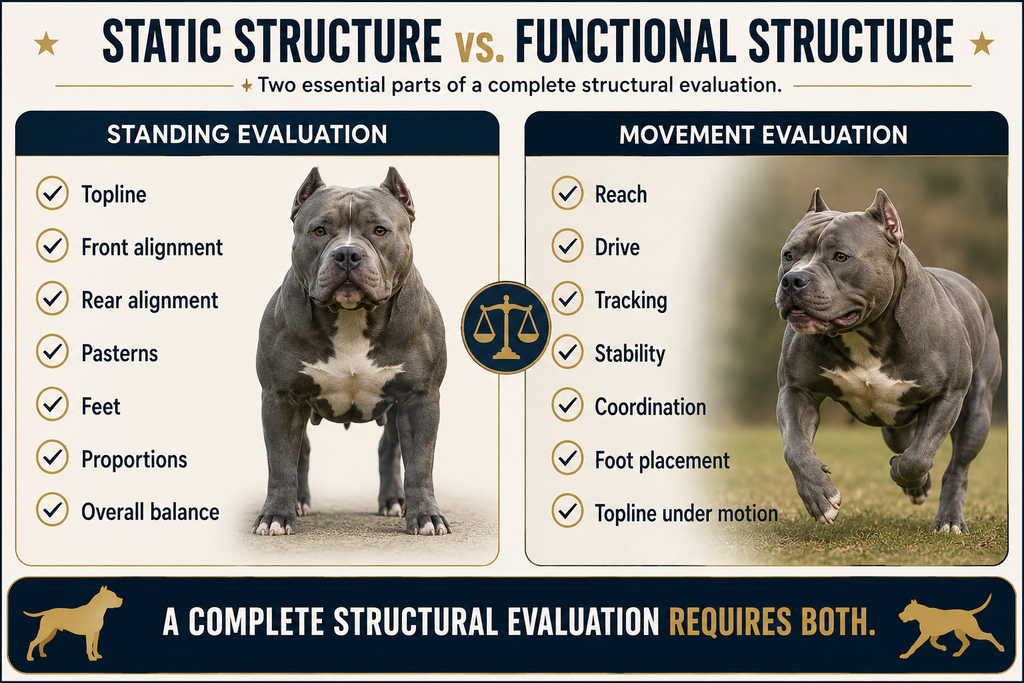
Static Structure vs. Functional Structure
A dog can look impressive while standing still and move poorly.
Likewise, photographs can conceal weaknesses through:
- camera angle
- foot placement
- stacking
- cropping
- surface choice
- selective photography
Responsible evaluation therefore requires examining both static structure and functional structure.
Standing Evaluation
Examine:
- proportions
- topline
- front alignment
- rear alignment
- pasterns
- feet
- chest
- shoulder placement
- overall balance
Movement Evaluation
Observe:
- reach
- drive
- tracking
- stability
- coordination
- foot placement
- topline under motion
A structurally impressive breeding dog should not merely look powerful.
It should be capable of moving naturally and efficiently.
Structure Should Be Evaluated at Multiple Ages
One of the biggest mistakes breeders can make is evaluating a puppy as though it were a finished adult.
Puppies develop unevenly.
During growth, breeders may temporarily see:
- high rears
- narrow chests
- softer pasterns
- awkward movement
- changing toplines
- disproportionate heads and bodies
- changes in foot direction
That does not make structural evaluation during puppyhood useless.
Experienced breeders learn to recognize developmental patterns while understanding that puppies remain unfinished.
8–10 Weeks
Early proportions and basic construction can begin to be observed.
4–6 Months
Developmental direction becomes more apparent, although significant growth remains.
9–12 Months
Skeletal relationships and movement become increasingly informative.
18–24 Months
Adult structure, muscle development, proportions, and mature balance can generally be evaluated much more reliably.
Breeding decisions should therefore rely heavily on mature evaluation rather than puppy appearance alone.
The Difference Between a Fault and an Exaggeration
This distinction is especially important in American Bully breeding.
A traditional structural fault represents an undesirable deviation in construction.
An exaggeration occurs when a recognizable or desirable breed characteristic is pushed beyond balanced proportions.
| Desirable Characteristic | Potential Exaggeration |
|---|---|
| Broad chest | Excessively wide front |
| Heavy bone | Distorted limb alignment |
| Large head | Disproportionate head |
| Muscular build | Excessive mass |
| Compact body | Extreme shortening |
| Powerful rear | Excessive angulation |
| Short muzzle | Excessive shortening that compromises function |
Responsible breeders should understand that exaggeration does not automatically improve breed type.
Sometimes it does exactly the opposite.
As discussed in Understanding Balance and Proportion in the American Bully, bigger, wider, shorter, or heavier does not automatically mean structurally better.
The strongest expression of breed type is found when distinctive appearance and functional anatomy remain in balance.
Structural Faults Should Not Be Evaluated in Isolation
Suppose a breeding prospect has a slightly east-west front.
Does that automatically mean the dog should never be bred?
Not necessarily.
Responsible breeding decisions are more nuanced.
Breeders should consider:
- severity of the weakness
- functional impact
- overall structure
- health screening
- temperament
- pedigree
- family history
- strengths elsewhere
- structure of the proposed mate
- consistency within the bloodline
- long-term breeding goals
The important principle is that breeders should recognize weaknesses rather than pretending they do not exist.
Every dog has strengths and weaknesses.
Responsible breeding requires understanding both.
This same whole-dog approach is central to How to Select Breeding Stock, where health, structure, genetics, temperament, and breed type are considered together rather than independently.
Avoid Doubling Up on Structural Weaknesses
One useful breeding principle is to avoid deliberately pairing dogs that demonstrate the same significant structural weakness.
For example, if a female has noticeably weak pasterns, selecting a male with the same weakness may increase the likelihood of reinforcing that characteristic within the breeding program.
Instead, breeders often look for complementary strengths when evaluating potential pairings.
But breeding is not as simple as:
Fault A + Correct Trait A = guaranteed correction.
Inheritance is much more complicated.
Many important structural characteristics are influenced by multiple genes. The principles explained in American Bully Genetics Explained help breeders understand why improving structure usually requires studying families and generations rather than expecting one mating to produce a guaranteed correction.
Breeders should examine:
- parents
- grandparents
- siblings
- half-siblings
- previous offspring
- related litters
A structurally correct individual from a family that consistently produces a particular weakness can provide very different information than appearance alone suggests.
Bloodlines Can Reveal Structural Patterns
A pedigree is more than a collection of famous names.
Bloodlines can reveal patterns.
Certain families may become known for consistently producing:
- strong toplines
- better shoulder placement
- heavy bone
- compact proportions
- powerful rears
- particular head types
- specific structural weaknesses
Studying American Bully bloodlines helps breeders understand why structural evaluation should extend beyond the individual dog standing in front of them.
Breeders should ask:
What does this dog look like?
But they should also ask:
What does this family consistently produce?
That second question becomes increasingly important when building a long-term breeding program.
Look at What a Dog Produces
Once a breeding dog has offspring, breeders gain another valuable source of information.
Ask:
- Are certain structural traits appearing repeatedly?
- Are offspring improving upon the parents?
- Are weaknesses becoming more pronounced?
- Are strengths reproducing consistently?
- Does the same fault appear with different mates?
- Are particular traits appearing throughout the family?
This is one reason responsible breeding programs require careful recordkeeping.
The goal is not simply to produce puppies.
The goal is to learn from every generation.
Health Testing and Structure Must Work Together
Visual structural evaluation cannot replace health screening.
A dog may appear structurally sound while carrying orthopedic, cardiac, genetic, or other health concerns that cannot be identified simply by watching it stand or move.
Likewise, satisfactory health-testing results do not automatically mean a dog possesses correct conformation.
Responsible breeders need both.
Breeders should work with their veterinarians and appropriate testing organizations to determine which evaluations are relevant to their dogs and breeding programs. Structural evaluation helps breeders understand how a dog is built and moves, while health testing can identify concerns that may not be visible from appearance alone.
For a complete breakdown of the role screening plays in breeding decisions, read TABB’s Health Testing for American Bullies: A Guide for Responsible Breeders.
Structural evaluation and health testing answer different questions.
Together, they provide a much more complete picture of a potential breeding dog.
Temperament Still Matters
A structurally impressive dog is not automatically a quality breeding prospect.
Temperament remains fundamental.
Breeders should consider:
- confidence
- stability
- sociability
- environmental adaptability
- handling tolerance
- predictable behavior
American Bully breeding should never become a beauty contest in which physical appearance overrides every other characteristic.
The complete breeding dog should be considered through multiple lenses:
Structure + Health + Genetics + Temperament + Pedigree + Production History
This broader philosophy is why responsible American Bully breeding practices emphasize evaluating the complete dog rather than breeding primarily for appearance or trends.
A Practical American Bully Structural Evaluation
A consistent evaluation process makes it easier to compare dogs objectively.
Step 1 — Observe the Dog Naturally
Before stacking or positioning the dog, watch how it naturally stands.
Look at:
- balance
- foot direction
- topline
- limb alignment
- weight distribution
Step 2 — Evaluate From the Front
Examine:
- chest
- shoulders
- elbows
- forearms
- wrists
- pasterns
- feet
Step 3 — Evaluate From the Side
Examine:
- head-to-body proportion
- neck
- shoulder angle
- upper arm
- topline
- body length
- rear angulation
- hocks
The head should also remain proportionate to the complete dog rather than being evaluated independently from the body.
Step 4 — Evaluate From Behind
Look for:
- rear alignment
- hock position
- foot direction
- symmetry
Step 5 — Watch the Dog Move
Observe the dog moving:
- toward you
- away from you
- from the side
Look for efficient, coordinated movement rather than simply dramatic movement.
Step 6 — Perform Hands-On Evaluation
Muscle and body condition can obscure underlying anatomy.
Hands-on examination can help breeders better understand:
- shoulder placement
- rib structure
- spine
- muscle condition
- joint relationships
Step 7 — Compare the Findings With the Family
Finally, examine whether observed strengths and weaknesses also occur among related dogs.
This transforms structural evaluation from simply judging an individual into evaluating a breeding family.
For breeders evaluating potential foundation dogs or future additions to a program, TABB’s How to Select Breeding Stock expands this process to include health, genetics, pedigree, temperament, and production potential.
Common Mistakes Breeders Make When Evaluating Structure
Even experienced breeders can become influenced by trends, preferences, social media, or kennel blindness.
Several mistakes deserve particular attention.
Evaluating Only From Photographs
Photographs provide useful documentation, but they cannot replace observing the dog naturally and in motion.
Prioritizing Headpiece Over the Entire Dog
A spectacular head cannot compensate for poor foundational structure.
Assuming More Muscle Means Better Structure
Muscle can enhance appearance but does not change underlying skeletal construction.
Confusing Extreme Width With Quality
Width without correct alignment can reduce structural balance.
Ignoring Feet and Pasterns
The foundation deserves as much attention as the head and chest.
Evaluating Puppies as Finished Adults
Growth can dramatically change proportions.
Breeding Two Dogs With the Same Weakness
Repeatedly reinforcing structural weaknesses can make them increasingly difficult to improve in future generations.
Following Trends Instead of Function
Breeding fashions change.
Sound anatomy remains important regardless of which appearance happens to be popular at the time.
The Goal Is Improvement, Not Perfection
No American Bully is structurally perfect.
The objective of responsible breeding is therefore not to find a mythical fault-free dog.
It is to understand each dog’s strengths and weaknesses well enough to make informed decisions.
A responsible breeder should be able to say:
“This dog has excellent qualities, and these are the areas I would like to improve in the next generation.”
That mindset is fundamentally different from kennel blindness.
Recognizing a dog’s weakness does not diminish its strengths.
It gives breeders information they can use to make better decisions.
Breed for the Dog That Can Still Function
American Bullies are known for their distinctive combination of substance, muscle, bone, broad proportions, and powerful appearance.
Those characteristics are an important part of breed identity.
But responsible breeding should preserve functionality within that type.
An American Bully should still be capable of:
- walking comfortably
- running
- playing
- standing naturally
- moving efficiently
- navigating normal environments
- enjoying everyday life
Structure should support those abilities rather than interfere with them.
Breeders should therefore resist the idea that every characteristic needs to become more extreme with each generation.
More width is not always better.
More bone is not always better.
A larger head is not always better.
A shorter body is not always better.
Better means the characteristic contributes to a dog that remains balanced, recognizable, functional, and structurally coherent.
See Responsible Breeding Principles in Practice
Education becomes more valuable when breeders and buyers can see how the same principles influence actual breeding decisions.
Capcity Bullys explains how structure is considered alongside temperament and pedigree in its American Bully breeding philosophy.
This provides a natural real-world example of the principle discussed throughout this article: a breeding decision should never be based on one dramatic characteristic alone.

SEE RESPONSIBLE BREEDING IN PRACTICE
Structure. Temperament. Pedigree.
See how structural evaluation, pedigree research, temperament, and thoughtful pairing decisions come together in an American Bully breeding program.
Building Better American Bullies
Structural evaluation is ultimately about the future.
Every breeding decision influences the next generation.
Selecting repeatedly for exaggerated characteristics without considering anatomy can gradually move a breeding program away from functional structure.
Selecting deliberately for balance can move it in the opposite direction.
Responsible breeders therefore ask more than:
“Will these puppies look impressive?”
They ask:
“What will this breeding contribute to the next generation?”
That question changes how breeding stock is evaluated.
It encourages breeders to study structure, movement, genetics, health, temperament, pedigrees, related dogs, and previous production together.
The breeder trying to build a long-term program should also study American Bully Genetics Explained, American Bully Bloodlines Explained, and How to Select Breeding Stock because structure becomes much more useful when it is understood as part of an entire breeding strategy.
The goal is not simply producing another litter.
The goal is producing a better generation than the one before it.
Continue Learning
Continue building your structural knowledge through the American Bully Structure Academy, TABB’s central resource for learning how balance, proportions, movement, and functional anatomy work together.
Next, study Understanding Balance and Proportion in the American Bully to learn why individual traits must be evaluated in relation to the entire dog.
Breeders planning future pairings should continue with How to Select Breeding Stock and Health Testing for American Bullies: A Guide for Responsible Breeders to connect structural evaluation with health, genetics, temperament, and long-term breeding decisions.
For deeper genetics education, read American Bully Genetics Explained and American Bully Bloodlines Explained.
Final Takeaway
The ability to recognize structural faults is not about criticizing dogs.
It is about understanding them.
Every breeding prospect has strengths and weaknesses. The breeder’s responsibility is to recognize both, understand how those traits appear throughout the dog’s family, and make pairing decisions with the next generation in mind.
The best structural evaluations look beyond head size, muscle, color, width, or a perfectly stacked photograph.
They ask whether the entire dog is balanced, stable, functional, and capable of moving comfortably.
When breeders combine that understanding with health screening, genetics, temperament, pedigree research, and responsible selection, structural evaluation becomes much more than judging appearance.
It becomes a tool for building healthier, more balanced, and more functional American Bullies for generations to come.