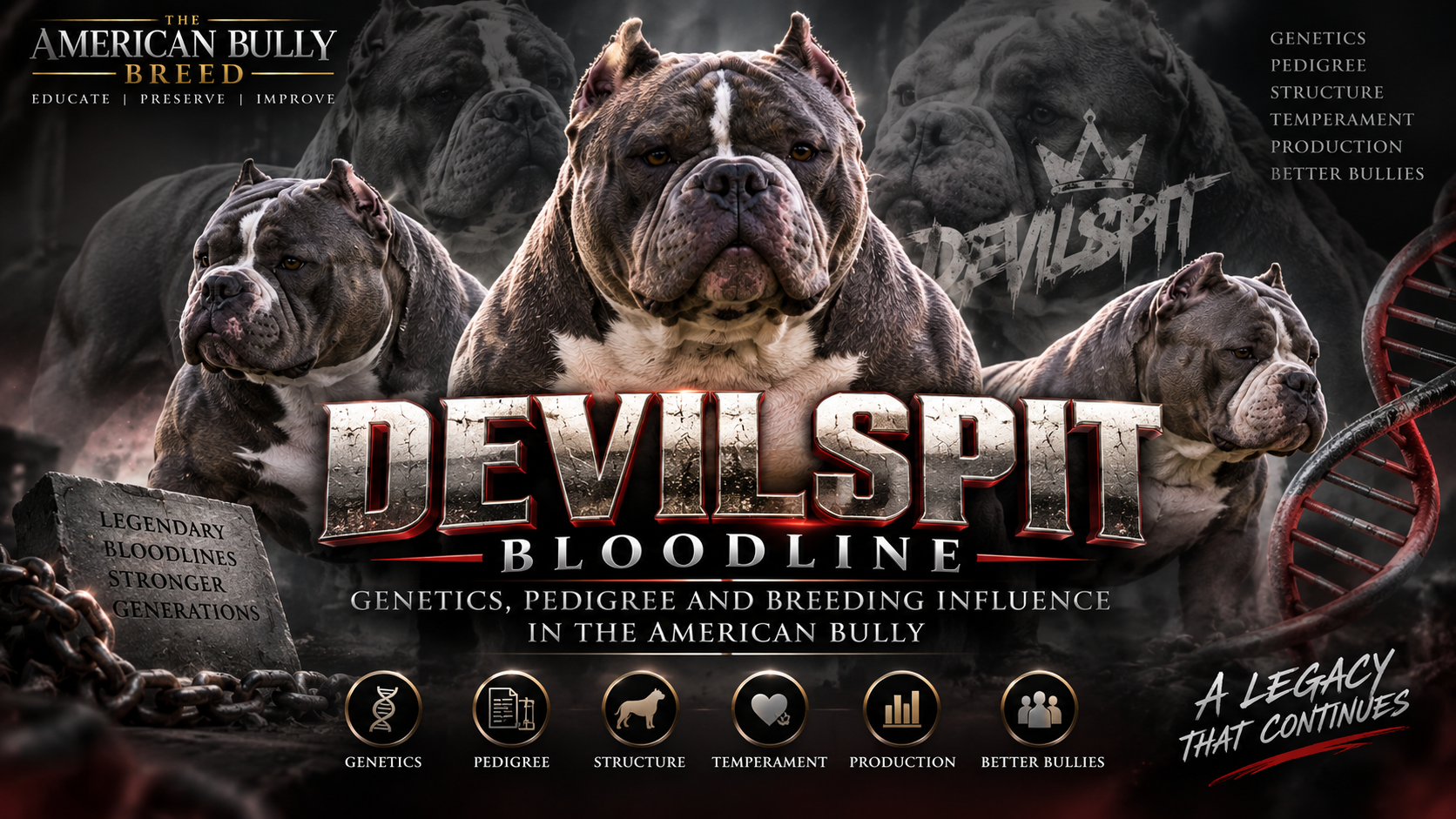
The Devilspit bloodline is a recognizable name within American Bully pedigrees, particularly among breeders and enthusiasts interested in compact, heavily built American Bullies.
But for a breeder, recognizing Devilspit in a pedigree is only the beginning.
The more important questions are:
Where does the Devilspit influence enter the pedigree?
Which descendants carried that influence forward?
What traits were actually reproduced?
What other genetics were introduced along the way?
Does the resulting dog complement the goals of the breeding program?
These questions transform bloodline recognition into pedigree analysis.
Devilspit is therefore useful not simply as a well-known name within the American Bully community, but as another case study for understanding how influential dogs and families can affect phenotype, genotype, structure, production and multi-generation breeding decisions.
This guide examines the Devilspit bloodline from that breeder-focused perspective.
Understanding the Devilspit Bloodline
The term bloodline is frequently used in the American Bully community to describe dogs descending from recognizable breeding families or influential producers.
However, a bloodline should not be treated as a guarantee of quality.
Finding Devilspit somewhere in a pedigree establishes ancestry.
It does not automatically tell a breeder:
- what the current dog looks like,
- how the dog moves,
- what its temperament is,
- what health information is available,
- which traits it inherited,
- or what it will produce.
Those questions require additional evaluation.
TABB’s American Bully Bloodlines Explained provides the foundation for understanding how breeders should interpret bloodlines and their influence across generations.
Why Devilspit Became Recognizable
Devilspit became associated within the American Bully community with compact bully type, muscular substance and distinctive physical characteristics. The line has continued appearing in pedigrees used by breeders developing compact American Bullies.
But breeders should distinguish between reputation and production.
A dog’s reputation may come from:
appearance
pedigree
show exposure
breeder promotion
social-media popularity
or
offspring
Only the last category begins answering the question breeders really need to understand:
What did the dog actually contribute genetically?
An influential producer becomes important when characteristics continue appearing through descendants with enough consistency that later breeders deliberately incorporate those genetics into their programs.
Devilspit in a Pedigree: Follow the Generations
When Devilspit appears several generations behind a breeding prospect, don’t stop at the name.
Trace the pedigree forward:
Devilspit
↓
Son or Daughter
↓
Grandson or Granddaughter
↓
Later Descendants
↓
Current Breeding Prospect
Study every important generation between the influential ancestor and the dog you’re evaluating.
Ask:
What traits persisted?
Did compactness, substance, head type, proportions or other characteristics continue appearing?
What changed?
Other bloodlines introduced during subsequent generations may substantially alter phenotype.
Which descendants became important producers?
Not every descendant contributes equally to a bloodline’s later influence.
What weaknesses appeared?
Breeder education requires studying undesirable outcomes just as carefully as desirable ones.
What was each descendant bred to?
Every generation represents two sides of a pedigree.
Attributing everything in a modern dog to one distant ancestor oversimplifies how inheritance works.
Pedigree Influence Is Not the Same as Percentage
Breeders sometimes talk about a dog being “heavy Devilspit” or carrying a particular amount of another bloodline.
That shorthand may help describe pedigree concentration, but it shouldn’t replace actual pedigree analysis.
An ancestor appearing multiple times can be important, but breeders still need to know:
where those appearances occur
which descendants connect them
what other dogs repeat
how closely related the parents are
and
what characteristics those branches actually produced
Pedigrees should be read as genetic relationships, not simply collections of recognizable names.
Phenotype vs. Genotype
Understanding Devilspit influence also requires understanding two fundamental concepts.
Phenotype
Phenotype is what breeders can observe.
Examples include:
- height,
- body proportions,
- head type,
- bone,
- chest,
- front assembly,
- rear assembly,
- topline,
- feet and pasterns,
- movement,
- coat,
- color,
- and temperament.
Genotype
Genotype refers to the genetic information carried by the dog.
A photograph provides information about phenotype.
It cannot reveal everything the dog carries genetically.
That’s why serious breeding evaluation combines:
physical evaluation + pedigree research + family history + health information + genetic testing + production records
Breeders who need a stronger foundation in these concepts should continue with American Bully Genetics Explained.
Don’t Breed to Devilspit — Breed to the Individual Dog
This distinction is fundamental.
A breeder shouldn’t select a stud simply because:
“He’s Devilspit.”
Instead ask:
“Is this individual dog appropriate for my female and the direction of my program?”
Imagine a male with strong Devilspit influence.
He may have desirable:
compactness
bone
head type
and
overall bully presence
But suppose he also has weaknesses in:
rear stability
feet
pasterns
or
movement
If the female possesses the same weaknesses, doubling down simply because both pedigrees are impressive may work against the breeding program.
Pedigree should help explain the dog.
Pedigree should never excuse the dog.
TABB’s How to Select Breeding Stock explains how breeders can combine pedigree information with structure, temperament, health and program objectives when evaluating potential breeding animals.
Structure Must Remain a Priority
Compact American Bullies can attract attention because of dramatic features.
But breeders should avoid allowing individual features to overwhelm evaluation of the complete dog.
Evaluate:
Head
↓
Neck
↓
Front
↓
Body
↓
Topline
↓
Rear
↓
Feet
↓
Overall balance
Then watch the dog move.
Evaluate:
reach
drive
tracking
stability
coordination
foot placement
and
topline under motion
TABB’s Understanding Balance and Proportion in the American Bully explains this whole-dog approach in greater detail.
Avoid Selecting for Exaggeration Alone
This is particularly important when working with compact bully genetics.
Breeders can easily fall into a cycle:
shorter
↓
wider
↓
heavier
↓
more extreme
↓
repeat
But breeding progress should not automatically be measured by increasing exaggeration.
A better objective is:
Develop recognizable type while preserving balance, movement, temperament and health.
A dog should not be evaluated as a collection of extreme features.
It should be evaluated as a complete animal.
That principle applies regardless of whether the pedigree contains Devilspit, Bape, Mr. Miagi or another influential family.
Devilspit and Complementary Breeding
Bloodlines become most useful when breeders understand how to use them within complementary pairings.
Suppose a female already possesses:
compact size
substantial bone
strong head type
but needs improvement in:
rear structure
movement
feet
or
overall balance.
The breeder shouldn’t automatically search for the most extreme Devilspit-influenced male available.
The better question is:
Which male provides characteristics that complement this female without unnecessarily reinforcing her weaknesses?
That moves the breeder away from bloodline collecting and toward breeding strategy.
Read How to Plan an American Bully Breeding Strategy for the broader framework behind these decisions.
Devilspit Combined With Other Influential Bloodlines
Modern American Bully pedigrees rarely exist in isolation.
Devilspit influence may appear alongside other recognizable families and producers.
TABB’s existing Bloodlines Explained resource, for example, discusses Devilspit alongside Bape, Miagi, Bullsace, Razor’s Edge, Gottiline and other influential names within the breed.
The important breeder question isn’t:
Which bloodline is best?
It’s:
What did each family contribute to this particular pedigree?
When studying a combination, ask:
Why were these families combined?
What was the breeder trying to improve?
What characteristics appeared in the offspring?
Were those characteristics reproduced in the next generation?
That last question is especially important.
One exceptional puppy does not necessarily demonstrate consistency.
Compare Devilspit, Bape and Mr. Miagi as Breeding Case Studies
Now that the TABB Genetics Academy contains individual studies of these influential names, breeders can begin comparing them properly.
Don’t compare them as:
Devilspit vs. Bape vs. Mr. Miagi — which is better?
That’s not particularly useful.
Instead compare:
pedigree influence
descendant production
phenotype
structural tendencies
how breeders combined the genetics
what later generations expressed
and
how those descendants fit into different breeding programs
Continue with TABB’s companion guides:
→ Mr. Miagi Bloodline: Influence on the American Bully and Breeding Programs
→ Bape Bloodline: Influence, Pedigree and Breeding Considerations in the American Bully
These three articles together begin forming a useful influential-bloodlines cluster within the Genetics Academy.
Health Cannot Be Assumed From a Bloodline
One point deserves particular emphasis.
A famous pedigree does not constitute health testing.
Every generation should be evaluated using contemporary health information appropriate to the dogs and breeding program.
That may include:
veterinary evaluation
orthopedic evaluation
cardiac evaluation
DNA testing
family health history
and other relevant screening.
The existing CB Devilspit article itself emphasizes health monitoring and responsible breeding practices, but a breeder-focused evaluation needs to go further by treating health as an independent selection criterion rather than assuming it from pedigree reputation.
Continue with TABB’s Health Testing for American Bullies.
Track Devilspit Influence in Your Own Program
If a breeder introduces Devilspit-influenced genetics, the most important research begins after the breeding.
Document the results.
For each litter, track:
Sire × Dam
Pedigree
Litter size
Structure
Development
Adult size
Movement
Temperament
Health information
Consistency among littermates
Strengths
Weaknesses
Then follow those dogs into adulthood.
If retained offspring enter the breeding program, continue documenting the next generation.
Over time, the breeder can begin answering a much more meaningful question:
What does this branch of Devilspit influence produce within my program?
That information is more useful than relying solely on what other breeders say the bloodline produces.
Study Production, Not Promotion
American Bully breeding exists in a highly visual environment.
Stud advertisements, professional photographs, social media, pedigree graphics and promotional banners can make a dog appear extremely desirable.
But breeders must separate:
marketing value
from
breeding value.
When evaluating a proven dog, study the offspring.
Ask:
What did he produce with different females?
Which characteristics repeated?
Did he improve weaknesses?
Did he reproduce his own strengths?
What weaknesses appeared repeatedly?
How did offspring mature?
What did his offspring produce when bred forward?
The deeper the production history, the more information a breeder has available.
Build a Program, Not a Collection of Famous Names
A pedigree containing:
Devilspit
Bape
Mr. Miagi
and several other recognizable dogs may look impressive.
But recognizable names don’t automatically create a coherent breeding program.
A program needs a destination.
Breeders should first establish:
What type am I trying to produce?
Which traits must be preserved?
Which weaknesses need improvement?
What health standards will guide selection?
What temperament am I trying to maintain?
How much consistency do I expect across generations?
Then bloodline selection becomes a tool for reaching those goals.
TABB’s American Bully Program Development Academy was built around exactly this long-term approach.
From Goals to Genetics
A logical breeder-development progression is:
Set Goals
↓
Develop a Breeding Philosophy
↓
Understand Genetics
↓
Study Bloodlines
↓
Select Breeding Stock
↓
Plan Complementary Pairings
↓
Evaluate Litters
↓
Track Traits Across Generations
↓
Improve Future Generations
Devilspit should be considered within this framework.
The objective shouldn’t be:
“How can I put Devilspit into my pedigree?”
It should be:
“Does this particular branch of Devilspit-influenced genetics contribute characteristics that advance the goals of my breeding program?”
That’s a substantially better breeding question.
Devilspit as a Genetics Academy Case Study
Studying Devilspit gives breeders another opportunity to apply the principles taught throughout the TABB Genetics Academy.
The learning progression becomes:
Influential ancestor
↓
Pedigree
↓
Descendants
↓
Genetic contribution
↓
Phenotype
↓
Production
↓
Complementary pairing
↓
Selection
↓
Future generations
That’s the real educational value of studying influential bloodlines.
The goal isn’t memorizing names.
The goal is understanding how breeding decisions move genetics through generations.
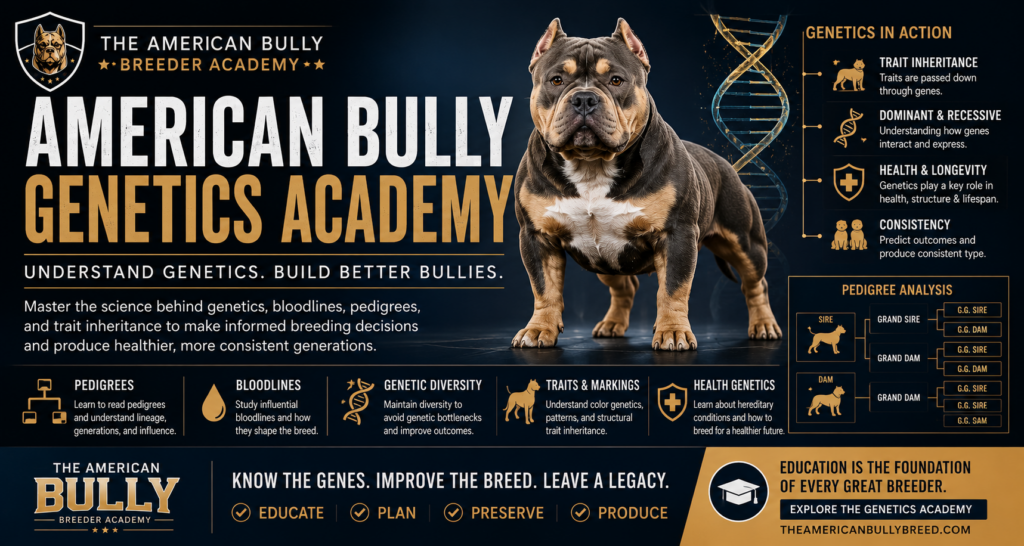
→ Explore the Genetics Academy
Explore American Bully Genetics and Bloodlines
Devilspit represents only one component of the much larger American Bully genetic landscape.
Continue building your understanding through these TABB breeder resources:
→ American Bully Genetics Explained
Learn the principles behind inheritance and genetic selection.
→ American Bully Bloodlines Explained
Understand how bloodlines develop and how breeders should evaluate them.
→ Mr. Miagi Bloodline: Influence on the American Bully and Breeding Programs
Study another influential pedigree through a breeder-development lens.
→ Bape Bloodline: Influence, Pedigree and Breeding Considerations in the American Bully
Examine Bape influence, production and breeding considerations.
→ How to Select Breeding Stock
Combine pedigree with structure, temperament, health and program objectives.
→ How to Plan an American Bully Breeding Strategy
Turn genetic information into deliberate breeding decisions.

From Breeder Education to the Marketplace
Understanding pedigrees and genetics helps breeders make better decisions. Presenting a responsible breeding program and connecting with qualified buyers requires another set of tools.
Bully Puppy Market is being developed as a dedicated American Bully marketplace where breeders can showcase puppies and buyers can discover breeding programs through a marketplace designed specifically around the breed.
→ Explore Bully Puppy Market
As BPM develops its breeder tools, the relationship becomes increasingly useful:
TABB teaches the breeder
↓
The breeder develops the program
↓
BPM helps the breeder present the program and reach buyers
That separation is exactly what I would maintain across the ecosystem.
Continue Through the TABB Genetics Academy
The three individual bloodline articles now form the beginning of a strong Genetics Academy sub-cluster:
American Bully Genetics Explained
↓
American Bully Bloodlines Explained
↓
↓
↓
Devilspit Bloodline
↓
How to Read an American Bully Pedigree
↓
Understanding Complementary Breeding
↓
Linebreeding vs. Outcrossing
↓
Tracking Traits Across Generations
That is the direction I’d continue taking the Genetics Academy.