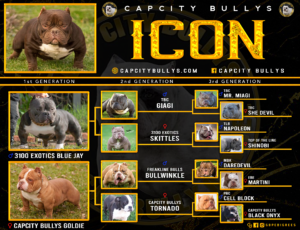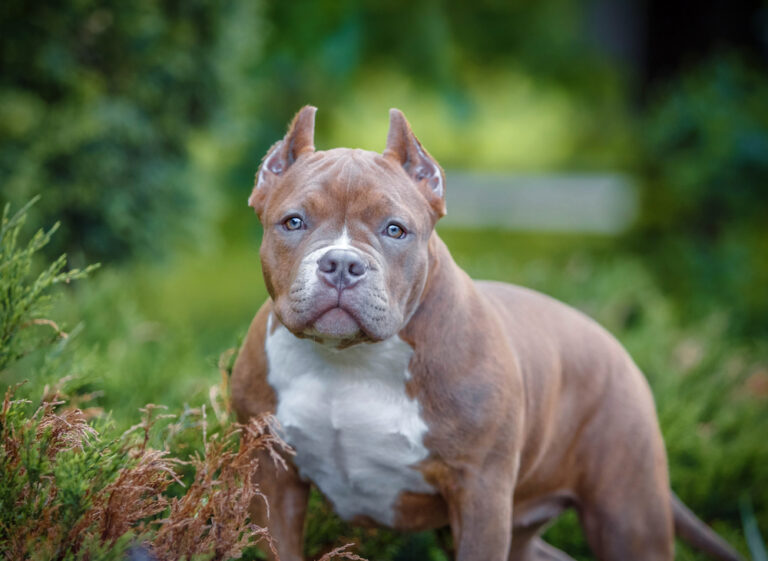
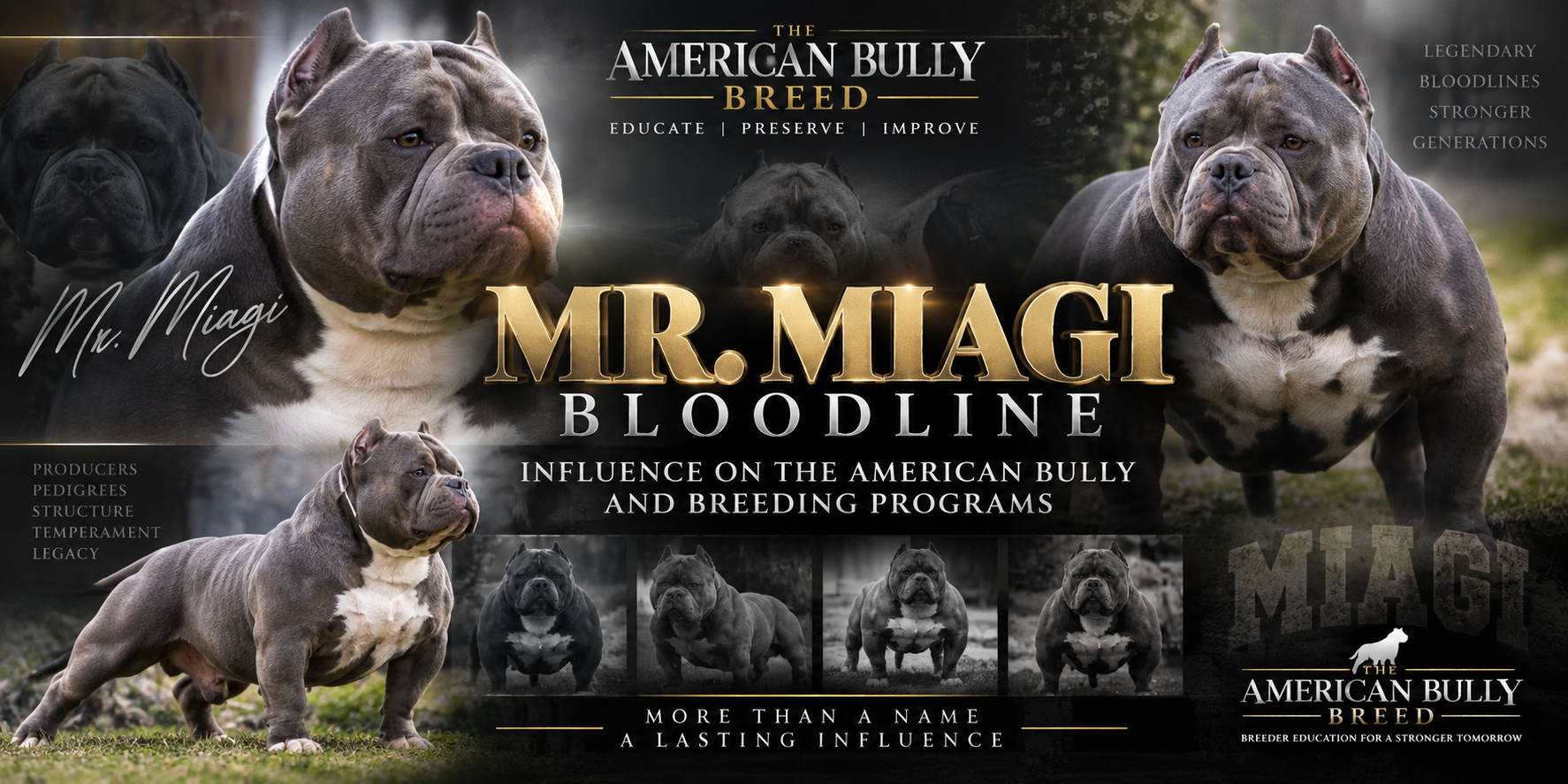
The Mr. Miagi bloodline has become one of the most recognizable names associated with the development of compact American Bullies. For breeders, however, understanding Mr. Miagi should go much deeper than recognizing a famous name somewhere in a pedigree.
A pedigree tells you where a dog came from. A breeding program must determine what those genetics actually produced, what continues to reproduce through descendants, and whether those traits complement the next breeding partner.
For students of The American Bully Breed’s breeder education resources, Mr. Miagi provides an excellent case study in how influential dogs can shape generations while also demonstrating why successful breeding decisions should never be based on a famous pedigree name alone.
This guide examines the Mr. Miagi bloodline from a breeder-development perspective: pedigree influence, phenotype, production, structure, complementary breeding, genetic diversity, health, and long-term program planning.
Who Was Mr. Miagi?
Mr. Miagi became widely recognized within American Bully breeding circles because of his compact appearance and the influence his descendants had on later generations of bully breeding.
His significance to breeders isn’t simply that he became well known.
The more important question is:
Why did breeders continue incorporating descendants carrying Mr. Miagi influence into subsequent breeding programs?
Influential breeding dogs generally become important because breeders believe certain characteristics are being reproduced with enough consistency to justify carrying those genetics forward.
That distinction matters.
A famous dog may have an impressive phenotype, but an influential producer must also demonstrate an ability to transmit desirable characteristics through offspring and later generations.
Breeders who want to better understand how ancestry contributes to a modern American Bully should also study TABB’s American Bully Bloodlines Explained.
Why the Mr. Miagi Bloodline Became Influential
The popularity of compact American Bullies created strong breeder interest in dogs capable of contributing shorter, heavier and more distinctive bully characteristics.
Mr. Miagi became associated with this movement, and his name subsequently appeared throughout pedigrees involving compact bully development.
But breeders should distinguish between three concepts:
Reputation
What breeders and the community associate with a particular dog or bloodline.
Phenotype
The physical and observable characteristics expressed by an individual dog.
Genetic contribution
The characteristics that a dog actually transmits to its offspring and that may continue appearing in subsequent generations.
These aren’t necessarily identical.
A dog can look exceptional without consistently producing its strongest characteristics.
Conversely, some dogs become highly influential because their offspring reproduce recognizable traits with greater consistency than might be expected from examining the parent alone.
Understanding that difference is fundamental to building a breeding program.
Bloodline Names Should Never Replace Evaluation
One of the most common mistakes newer breeders make is assuming that the presence of a famous name automatically improves a pedigree.
It doesn’t.
Seeing Mr. Miagi several generations behind a puppy tells a breeder something about ancestry, but it doesn’t answer:
- Which traits actually traveled through those generations?
- Which descendants were strong producers?
- What structural characteristics appeared?
- What weaknesses appeared?
- How consistent was the production?
- What other genetics were introduced?
- How distant is the influential ancestor?
- What does the dog standing in front of you actually express?
This is why pedigree analysis must accompany physical and functional evaluation.
TABB’s How to Select Breeding Stock explains the broader process of evaluating potential breeding dogs rather than selecting them primarily because of pedigree recognition.
Mr. Miagi Influence and the Modern Compact Bully
Mr. Miagi’s influence is especially relevant when studying the development of compact American Bullies and dogs commonly described today as Micro Bullies.
However, breeders should be careful with terminology.
The presence of Mr. Miagi ancestry doesn’t automatically determine a dog’s size, structure, quality or classification.
Modern dogs carrying influence from historically significant lines may also contain numerous other bloodlines.
That means breeders should evaluate the complete pedigree, not isolate one recognizable ancestor.
A pedigree should be viewed as a genetic map.
Each generation contributes information about how the dog was produced and potentially helps explain why certain characteristics appear.
The farther back an individual ancestor appears, the more important it becomes to examine the descendants connecting that ancestor to the dog being evaluated.
Phenotype vs. Genotype in Bloodline Evaluation
This distinction is critical for breeders.
Phenotype
Phenotype describes the characteristics you can observe:
- Height
- Body proportions
- Head type
- Bone
- Chest
- Front assembly
- Rear assembly
- Topline
- Feet and pasterns
- Movement
- Coat and color
- Temperament
Genotype
Genotype refers to the genetic information carried by the dog.
A breeder can’t fully understand genotype simply by looking at the dog.
That is one reason pedigree research, health testing, genetic testing and evaluation of relatives are important.
A dog may visually resemble an influential ancestor while carrying a much broader combination of genetics.
Likewise, a dog that doesn’t strongly resemble a famous ancestor could still carry and reproduce certain characteristics inherited through that family.
Responsible breeders therefore evaluate both what a dog is and what the family behind the dog has demonstrated it can produce.
Evaluate the Descendants, Not Just Mr. Miagi
When studying an influential dog, one of the most useful exercises is examining multiple generations of descendants.
Don’t stop at:
Mr. Miagi
Study:
Mr. Miagi
↓
sons and daughters
↓
grandsons and granddaughters
↓
later descendants
Then ask:
What continued appearing?
Were certain proportions, head characteristics, size tendencies or structural characteristics repeatedly expressed?
What changed?
Did later breeders introduce other bloodlines that significantly altered type?
Which descendants became influential producers themselves?
Some branches of a family may become considerably more important than others.
What weaknesses repeatedly appeared?
This question is just as important as identifying strengths.
A breeder isn’t performing meaningful pedigree research if only desirable characteristics are recorded.
Structure Must Remain Part of the Conversation
Famous bloodlines should never be used as justification for overlooking structural weaknesses.
A compact American Bully still needs to function as a dog.
Breeders should evaluate:
- Overall balance
- Front assembly
- Rear assembly
- Topline
- Pasterns
- Feet
- Shoulder placement
- Angulation
- Movement
- Coordination
- Proportion
TABB’s Understanding Balance and Proportion in the American Bully explains why individual features should be evaluated as parts of the entire dog rather than in isolation.
A large head doesn’t compensate for poor movement.
Extreme width doesn’t compensate for instability.
Short stature doesn’t compensate for poor proportions.
And a famous bloodline doesn’t compensate for structural problems.
Static Structure vs. Functional Structure
Breeders frequently evaluate dogs in stacked photographs.
Photographs are useful, but they’re incomplete.
A dog should also be evaluated while moving.
Standing evaluation can help breeders examine:
topline → front alignment → rear alignment → pasterns → feet → proportions → overall balance
Movement evaluation provides additional information about:
reach → drive → tracking → stability → coordination → foot placement → topline under motion
This is particularly important when working with compact dogs, where excessive exaggeration can sometimes become prioritized over functional balance.
The objective should not simply be:
Make the next generation shorter, wider or heavier.
The better objective is:
Preserve desirable type while improving the complete dog.
Complementary Breeding and Mr. Miagi-Influenced Dogs
One of the most important concepts in breeding is complementary pairing.
Breeders shouldn’t ask only:
“Does this stud have Mr. Miagi?”
They should ask:
“What does this dog contribute that complements my female?”
Suppose a female already has substantial compactness and bone but could benefit from improvements in movement, rear stability or overall balance.
Selecting an even more exaggerated male simply because he carries a recognizable bloodline may reinforce the very weaknesses the breeder should be trying to improve.
A complementary pairing looks at:
Strengths of Dog A
against
Strengths and weaknesses of Dog B
and asks whether the combination supports the long-term objectives of the program.
This connects directly to TABB’s How to Plan an American Bully Breeding Strategy.
Bloodline Popularity vs. Breeding Compatibility
Popularity and compatibility aren’t the same thing.
A currently fashionable stud might generate attention on social media, but that doesn’t automatically make him appropriate for a particular female.
Before selecting a pairing, breeders should evaluate:
Structure
Does one dog compensate for weaknesses in the other?
Temperament
Are both dogs demonstrating stable, appropriate temperaments?
Health
Have appropriate health evaluations and genetic tests been performed?
Pedigree
What genetic relationships exist between the two dogs?
Production
For proven dogs, what have they already produced?
Program objective
What is the breeder actually attempting to improve or preserve?
These questions should carry more weight than pedigree popularity.
Health Testing Still Matters With Famous Bloodlines
Historical pedigree influence doesn’t eliminate the need for contemporary health testing.
Every generation should be evaluated on its own merits.
A breeder should consider appropriate testing based on the dogs, family history and breeding goals rather than assuming pedigree reputation provides health assurance.
TABB’s Health Testing for American Bullies provides a broader introduction to incorporating health evaluation into responsible breeding decisions.
Health information should also be documented across generations whenever possible.
Over time, those records can become extremely valuable when evaluating whether particular combinations are producing consistent outcomes.
Linebreeding, Outcrossing and Mr. Miagi Influence
Breeders may encounter Mr. Miagi multiple times within extended pedigrees.
That alone doesn’t tell you whether the pedigree represents an appropriate breeding strategy.
The breeder needs to examine:
- Where the ancestor appears
- How many times the ancestor appears
- Which descendants connect those appearances
- What other bloodlines are present
- Degree of relatedness
- What characteristics those families produced
- Why the concentration exists
Linebreeding may be used to concentrate particular family characteristics, while outcrossing introduces genetics from less closely related families.
Neither strategy is automatically good or bad.
The important question is whether the breeder understands why the pairing is being made and what the genetic strategy is intended to accomplish.
A Pedigree Is More Than a List of Famous Dogs
A pedigree containing several recognizable names can look impressive.
But breeders should learn to read pedigrees as relationships between generations.
Consider:
Dog being evaluated
↓
Sire × Dam
↓
Four grandparents
↓
Eight great-grandparents
↓
Sixteen dogs in the next generation
The breeder should study how those families intersect.
This is where pedigree research becomes much more valuable than simply advertising:
“Miagi blood.”
The better questions are:
Where does the influence enter the pedigree?
What descendants carried it forward?
What was it combined with?
What did those combinations produce?
That’s pedigree analysis.
Track What Your Own Program Produces
Once a breeder incorporates Mr. Miagi-influenced genetics—or any established bloodline—the next responsibility is documenting the results.
For every breeding, record:
Pairing
Pedigree
Litter size
Structure
Size and development
Temperament
Health information
Consistency
Traits shared among littermates
Traits that changed as puppies matured
Then compare subsequent generations.
This connects directly with the philosophy behind TABB’s American Bully Program Development Academy: breeding decisions should form part of a long-term program rather than a sequence of unrelated pairings.
Don’t Chase a Bloodline — Build a Program
There is an important difference between:
owning dogs with impressive pedigrees
and
developing a breeding program.
A breeding program requires direction.
Before incorporating any influential bloodline, breeders should know what they are trying to accomplish.
TABB recommends beginning with clearly defined goals. Read How to Set Goals for an American Bully Breeding Program and then develop the principles that will guide those decisions in How to Develop an American Bully Breeding Philosophy.
A breeder’s question shouldn’t simply be:
“How do I get Mr. Miagi into my pedigree?”
It should be:
“Does this family contain characteristics that help move my breeding program toward its defined goals?”
That is a much more useful breeding question.
Mr. Miagi as a Breeder-Education Case Study
The lasting value of studying influential American Bully dogs isn’t merely learning their names.
They provide an opportunity to understand:
how individual dogs influence populations
how traits travel through generations
how descendants can become influential producers themselves
how breeders combine established families
how phenotype and pedigree interact
how selection changes a bloodline over time
and ultimately:
how deliberate breeding decisions create consistency.
Mr. Miagi is therefore useful not only as an important name within American Bully history, but as a case study in how breeders should analyze influential ancestry.
AMERICAN BULLY GENETICS ACADEMY
Understand Genetics. Study Pedigrees. Build Better Breeding Programs.
→ Explore the Genetics Academy
Explore American Bully Bloodlines
Understanding Mr. Miagi is only one part of learning how American Bully bloodlines develop.
Continue through The American Bully Breed to study pedigrees, genetics, influential dogs, breeding strategies and multi-generation program development.
Continue Learning
→ American Bully Bloodlines Explained
Learn how bloodlines develop and how breeders should interpret them.
→ American Bully Genetics Explained
Build the genetic foundation needed for better pedigree and breeding decisions.
→ How to Select Breeding Stock
Learn how pedigree, structure, temperament, health and production should work together when evaluating breeding prospects.
→ How to Plan an American Bully Breeding Strategy
Turn pedigree information into deliberate multi-generation breeding decisions.
→ American Bully Program Development Academy
Build a breeding program around goals, evaluation, consistency and long-term improvement.
Explore the American Bully Marketplace
Pedigree education is most useful when breeders can apply it to real-world breeding decisions.
Bully Puppy Market (BPM) is being developed as a dedicated American Bully marketplace connecting responsible breeders with buyers while providing a growing platform for breeder profiles, puppy discovery and breeder resources.
As BPM develops, its breeder tools can complement TABB’s educational mission by helping breeders move from learning about pedigrees and breeding strategy to managing and presenting their own programs.
TABB Navigation Footer
Continue Your Breeder Education
Bloodlines & Genetics
American Bully Bloodlines Explained → American Bully Genetics Explained → Mr. Miagi Bloodline → Bape Bloodline (next recommended Bloodline Academy article)
Program Development
American Bully Program Development Academy → How to Set Goals for an American Bully Breeding Program → How to Develop an American Bully Breeding Philosophy → How to Plan an American Bully Breeding Strategy
Health & Testing
Health Testing for American Bullies
Marketplace Resource
Explore Bully Puppy Market